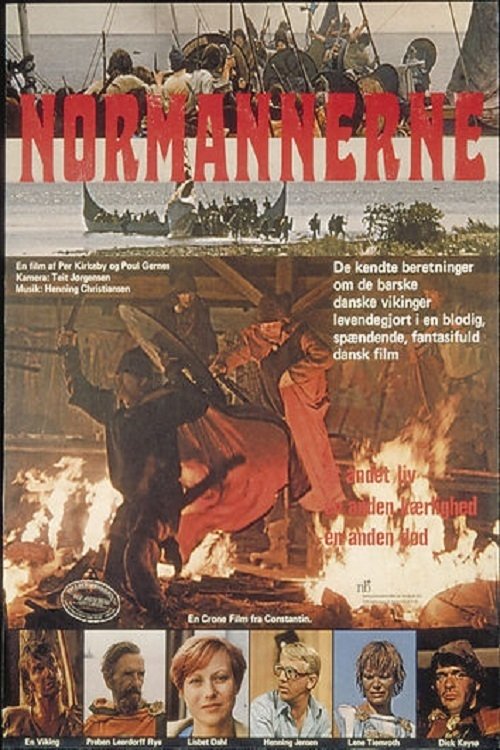
A 1976 Danish documentary adapting Saxo Grammaticus's Gesta Danorum through avant-garde filmmaking and historical performance.
Story Structure — 4 Plot Phases
Historical Foundations & Source Material
The documentary introduces Saxo Grammaticus's Gesta Danorum as its primary textual foundation. Directors Kirkeby and Gernes establish their artistic vision for adapting the 12th-century chronicle.
Key Events
Documentary Introduction — Opening credits establish the documentary format and production team.
Location: Danish Film Studio
Historical Source Introduction — The film introduces Saxo Grammaticus's 12th-century text as its foundation.
Location: Archival Library
Directorial Vision Presentation — Kirkeby and Gernes outline their artistic approach to the historical material.
Location: Director's Workspace
Script Adaptation Process — Kirkeby adapts the medieval chronicle into a cinematic narrative structure.
Location: Writing Room
Cast Assembly & Auditions — Key actors are selected to portray figures from the Norman era.
Location: Casting Studio
Cinematography Setup — Jørgensen establishes the visual language and camera movements.
Location: Film Set
Artistic Adaptation & Filmmaking Process
The production team assembles the cast and begins principal photography. Cinematographer Teit Jørgensen and editor Maj Soya develop the visual and narrative structure.
Key Events
Cinematography Setup — Jørgensen establishes the visual language and camera movements.
Location: Film Set
Performance Rehearsals — Actors refine their portrayals of historical characters through dialogue.
Location: Rehearsal Hall
Historical Context Exploration — The documentary delves into the political landscape of 12th-century Denmark.
Location: Historical Archive
Artistic Interpretation Phase — Directors blend historical accuracy with avant-garde artistic expression.
Location: Art Studio
Principal Photography Begins — Main filming commences with the ensemble cast in period settings.
Location: Outdoor Locations
Cinematic Composition Refinement — Jørgensen adjusts framing and lighting to enhance narrative mood.
Location: Film Set
Performance & Visual Execution
Actors deliver nuanced portrayals of historical figures while directors integrate avant-garde visual metaphors. The editing room becomes the focal point for pacing refinement.
Key Events
Cinematic Composition Refinement — Jørgensen adjusts framing and lighting to enhance narrative mood.
Location: Film Set
Editing Room Assembly — Soya begins structuring the raw footage into a coherent documentary flow.
Location: Editing Suite
Narrative Pacing Adjustment — Directors and editor refine the rhythm to match the source material's tone.
Location: Editing Suite
Character Dynamics Development — Interactions between historical figures are highlighted through performance.
Location: Film Set
Visual Metaphor Integration — Gernes introduces visual motifs to represent Norman cultural themes.
Location: Art Studio
Climactic Historical Episodes — Key conflicts from Gesta Danorum are dramatized with high intensity.
Location: Dramatic Set
Thematic Resolution & Cultural Legacy
Climactic historical conflicts are dramatized and resolved within the documentary framework. The film concludes with a reflection on its artistic and cultural significance.
Key Events
Climactic Historical Episodes — Key conflicts from Gesta Danorum are dramatized with high intensity.
Location: Dramatic Set
Thematic Resolution — The documentary synthesizes historical events into a cohesive cultural statement.
Location: Narrative Space
Final Editing Pass — Soya completes the final cut, balancing visuals, dialogue, and pacing.
Location: Editing Suite
Runtime Completion — The 89-minute documentary reaches its structural conclusion.
Location: Production Office
Cultural Legacy Assessment — The film's impact on Danish documentary and historical cinema is evaluated.
Location: Film Archive
Story Breakdown
Historical Source Foundation — Establishes the 12th-century text as the narrative backbone.
Gesta Danorum Text — Saxo Grammaticus chronicle introduction
Danish Historical Context — Political landscape of the era
Directorial Vision — Kirkeby and Gernes blend art and documentary formats.
With "The Normans," painters Paul Gernes and Per Kirkeby wanted to make a film about the Viking Age, but not a traditional fiction film set in that period. Instead, the film has a contemporary setting, in which a guide shows various historical sites and tries to bring the past to life, even though she has only one interested listener. Within this framework, episodes from Danish mythology are brought to life: King Skjold, Rolf Krake, Regnar Lodbrog, the Battle of Svold, etc. The film mainly follows the account in Saxo's chronicle, but also dramatizes a story by the Arab author Ibn Fadlan. He described the cremation of a Viking chieftain in Russia around the year 900, where, among other things, a slave woman was sacrificed after ritual intercourse. The film is based on a number of historical and archaeological studies. The loose form is intended to emphasize how fragmentary our knowledge of the Viking Age actually is.