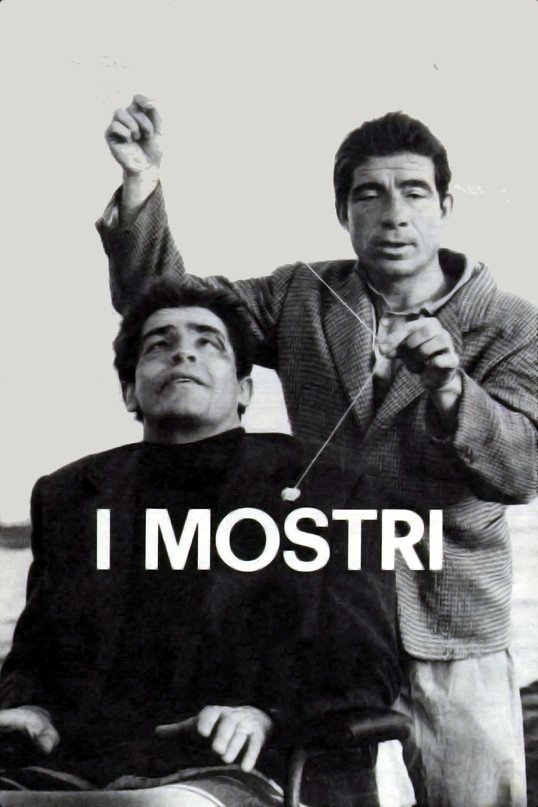
Plot Analysis Summary
A sequence of comic and unsettling episodes portrays selfishness, hypocrisy, exploitation, and self-deception as ordinary behavior.
Story Structure — 6 Plot Phases
The Child of Bad Lessons
The Father teaches his son to refuse help, cheat, and ignore rules through his own petty dishonesty. He treats the boy's resulting behavior as a success.
Key Events
-
Lessons in Refusal — The Father teaches his young son that refusing help is safer than assisting others. Characters: The Father (segment "L'Educazione sentimentale") / Policeman (segment "Il Mostro") / Stefano (segment "Come un Padre") / Battacchi (segment "Il povero Soldato") / L'Onorevole (segment "La Giornata dell'Onorevole") / Dark Latin Lover (segment "Latin Lovers
Location: Unspecified
-
Petty Dishonesty — He underpays for food and takes extra sweets while modeling selfishness. Characters: The Father (segment "L'Educazione sentimentale") / Policeman (segment "Il Mostro") / Stefano (segment "Come un Padre") / Battacchi (segment "Il povero Soldato") / L'Onorevole (segment "La Giornata dell'Onorevole") / Dark Latin Lover (segment "Latin Lovers
Location: Unspecified
-
A Child Learns to Cheat — The Father encourages his son to cheat and disregard rules. Characters: The Father (segment "L'Educazione sentimentale") / Policeman (segment "Il Mostro") / Stefano (segment "Come un Padre") / Battacchi (segment "Il povero Soldato") / L'Onorevole (segment "La Giornata dell'Onorevole") / Dark Latin Lover (segment "Latin Lovers
Location: Unspecified
-
Pride in the Trickster — He boasts about the boy's behavior as if his lessons succeeded. Characters: The Father (segment "L'Educazione sentimentale") / Policeman (segment "Il Mostro") / Stefano (segment "Come un Padre") / Battacchi (segment "Il povero Soldato") / L'Onorevole (segment "La Giornata dell'Onorevole") / Dark Latin Lover (segment "Latin Lovers
Location: Unspecified
Suspicion After the Cinema
A husband worries about his wife's repeated late returns from the cinema. Although a friend advises him not to accuse her without proof, his jealousy grows.
Key Events
-
Late Cinema Returns — A husband worries about his wife's regular late returns from the cinema. Characters: Wife at Cinema (segment "Scenda l'Oblio")
Location: Cinema
-
A Friend Advises Caution — A friend urges the suspicious husband not to accuse his wife without proof.
Location: Unspecified
-
Jealousy Grows — The husband's jealousy grows as he considers her routine and his late-night work. Characters: Wife at Cinema (segment "Scenda l'Oblio")
Location: Unspecified
Integrity on Hold
General Olivazzi seeks help over a land valuation dispute. L'Onorevole speaks of duty but repeatedly postpones seeing him while attending to other engagements.
Key Events
-
Olivazzi Appeals — Olivazzi raises a land valuation dispute with L'Onorevole. Characters: General Olivazzi (segment "La Giornata dell'Onorevole"), The Father (segment "L'Educazione sentimentale") / Policeman (segment "Il Mostro") / Stefano (segment "Come un Padre") / Battacchi (segment "Il povero Soldato") / L'Onorevole (segment "La Giornata dell'Onorevole") / Dark Latin Lover (segment "Latin Lovers, Ministry of Public Works's Director (segment "La Giornata dell'Onorevole")
Location: Unspecified political office
-
Duty Declared — L'Onorevole insists that he must perform his duty. Characters: The Father (segment "L'Educazione sentimentale") / Policeman (segment "Il Mostro") / Stefano (segment "Come un Padre") / Battacchi (segment "Il povero Soldato") / L'Onorevole (segment "La Giornata dell'Onorevole") / Dark Latin Lover (segment "Latin Lovers, General Olivazzi (segment "La Giornata dell'Onorevole")
Location: Unspecified political office
-
Repeatedly Postponed — The politician delays seeing Olivazzi while prioritizing other engagements. Characters: The Father (segment "L'Educazione sentimentale") / Policeman (segment "Il Mostro") / Stefano (segment "Come un Padre") / Battacchi (segment "Il povero Soldato") / L'Onorevole (segment "La Giornata dell'Onorevole") / Dark Latin Lover (segment "Latin Lovers, General Olivazzi (segment "La Giornata dell'Onorevole")
Location: Unspecified political office
The Singer's False Hope
Street performers exploit a blind young man by having him sing for donations. Professor Pinzuto offers a free operation that might restore his sight, but the performers leave for a more profitable location.
Key Events
-
A Blind Singer Exploited — Street performers make a blind young man sing to attract donations. Characters: Professor Pinzuto (segment "I due Orfanelli")
Location: Street
-
An Operation Offered — Pinzuto offers an examination and a potentially sight-restoring operation for free. Characters: Professor Pinzuto (segment "I due Orfanelli")
Location: Unspecified
-
The Performers Move On — The performers leave for a more profitable location and continue seeking donations.
Location: Street
-
A Promise of Pilgrimage — The performers promise a pilgrimage if their plans succeed.
Location: Unspecified
Private Lives Exposed
A man warns Giuliana that he feels responsible for wasting her years and may hurt her. In another vignette, a woman sees that a writer's fictional character reflects his own life.
Key Events
-
A Warning to Giuliana — A man tells Giuliana he feels responsible for lost years and warns he will hurt her. Characters: Giuliana (segment "Il Sacrificato")
Location: Unspecified
-
Fiction Mirrors Life — A woman recognizes that the writer's supposedly fictional character draws on his life. Characters: The Debutant Writer (segment "La Musa")
Location: Unspecified
Domestic Dependence
The Wife's lover visits while her husband watches television. The husband's demand for calming medicine exposes dependence and domestic resentment.
Key Events
-
An Unwelcome Visitor — The Wife's lover visits while her husband watches television. Characters: The Wife (segment "L'Oppio dei Popoli")
Location: Home
-
Demand for Medicine — The husband demands the calming medicine on which he has been relying. Characters: The Wife (segment "L'Oppio dei Popoli")
Location: Home