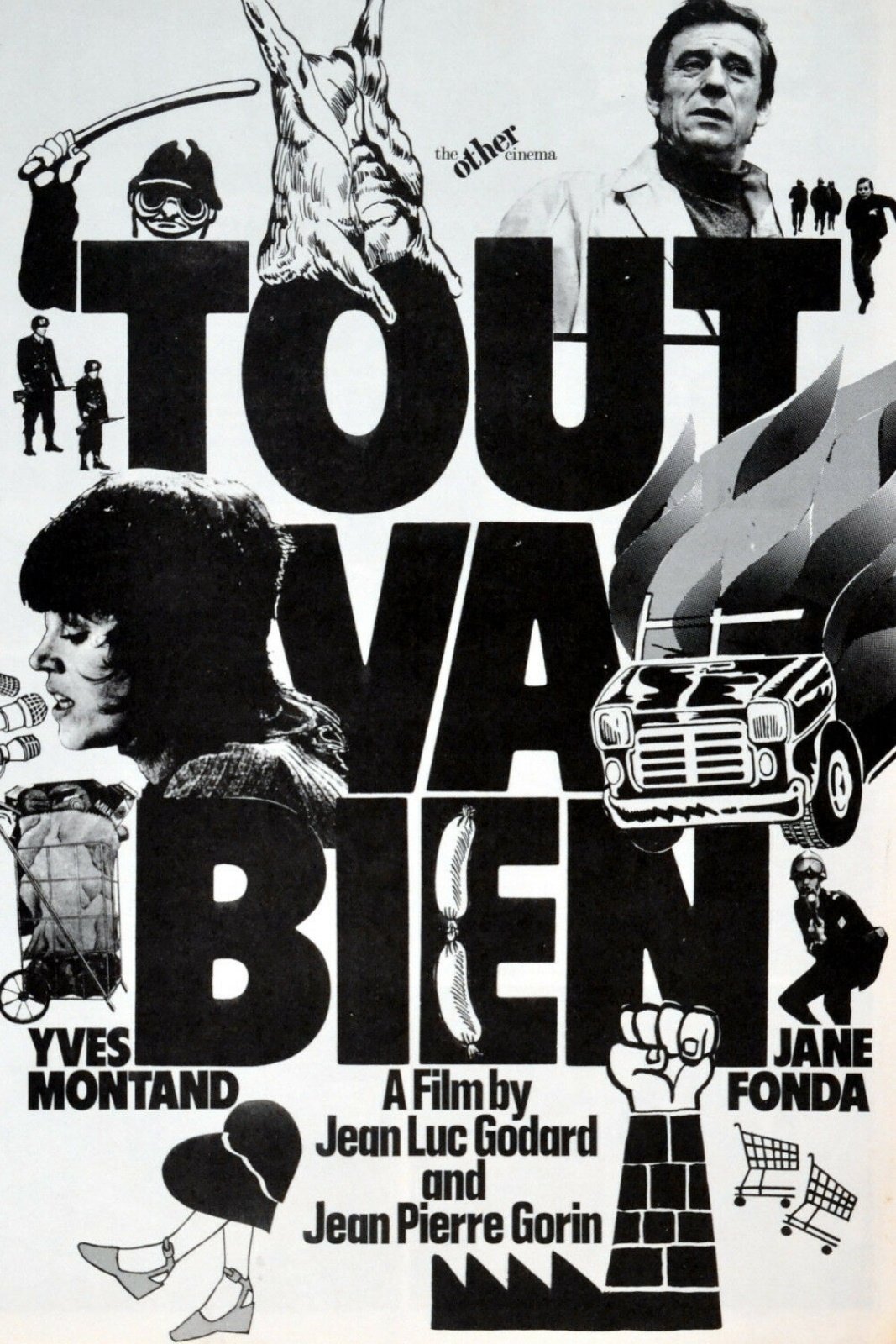
Story Structure — 4 Plot Phases
Strike and Observation
The narrative opens with a labor strike at a sausage factory, witnessed by an American reporter and her French husband. Their presence establishes the observational framework for the unfolding events.
Key Events
-
Sausage Factory Strike Begins — Workers initiate a strike at the factory, observed by the main couple.
Location: Sausage Factory
-
Couple Observes Conflict — The reporter and husband witness the unfolding labor dispute.
Location: Factory Exterior
-
Political Message Delivery — Directors embed a strong political message about French class dynamics.
Location: Cinematic Space
Political and Social Critique
The film shifts focus to outline the logic of class struggle in post-1968 France. It examines the destructive impact of capitalism on society, embedding a strong political message within the narrative.
Key Events
-
Class Struggle Analysis — The narrative outlines the logic of class struggle in post-1968 France.
Location: Factory Interior
-
Capitalism Destruction Theme — The film examines how capitalism causes widespread social destruction.
Location: Social Landscape
-
Brechtian Distancing Applied — Actors deliberately distance themselves from the audience to prevent immersion.
Location: Film Set
Cinematic Technique and Set Design
Directors introduce Brechtian distancing techniques and a cross-sectioned factory set. The camera dolly movement through walls breaks traditional spatial continuity, forcing awareness of the film's constructed nature.
Key Events
-
Brechtian Distancing Applied — Actors deliberately distance themselves from the audience to prevent immersion.
Location: Film Set
-
Cross-Sectioned Factory Set — A unique set design allowing visibility through walls between rooms.
Location: Sausage Factory
-
Camera Dolly Movement — The camera moves back and forth through rooms, simulating wall penetration.
Location: Factory Interior
-
Fourth Wall Breaking Technique — The set design forces viewers to acknowledge they are watching a constructed film.
Location: Cinematic Space
-
Audience Film Awareness — Viewers are made conscious of the film's artificial nature.
Location: Theater Space
-
Direct Camera Address — Characters look directly into the camera, breaking narrative illusion.
Location: Film Set
Directorial Execution and Audience Engagement
Self-reflexive methods like direct camera address, long takes, and abandoned continuity editing are deployed. Performers distance themselves from the audience, prompting broader inferences about the film's meaning.
Key Events
-
Direct Camera Address — Characters look directly into the camera, breaking narrative illusion.
Location: Film Set
-
Long Take Execution — Extended continuous shots replace traditional editing to maintain realism.
Location: Factory Interior
-
Continuity Editing Abandonment — Directors reject standard continuity editing to disrupt narrative flow.
Location: Editing Room
-
Diegesis Disruption — The story world is intentionally fractured to prevent emotional attachment.
Location: Cinematic Space
-
Broader Inference Prompting — Viewers are guided toward drawing broader inferences about the film's meaning.
Location: Theater Space
-
Self-Reflexive Integration — Multiple self-reflexive techniques are combined to highlight filmmaking artifice.
Location: Film Production
-
Historical Unrest Reflection — The narrative reflects on the aftermath of the 1968 civil unrest.
Location: French Society
-
Social Critique Presentation — The film presents a direct critique of capitalist social structures.
Location: Social Landscape
-
Cinematic Reality Acknowledgment — The boundary between reality and cinematic construction is fully exposed.
Location: Film Set
-
Thematic Resolution — The film concludes by leaving viewers with unresolved political and social questions.
Location: Cinematic Space
A strike at a French sausage factory contributes to the estrangement of a married filmmaker and his reporter wife.