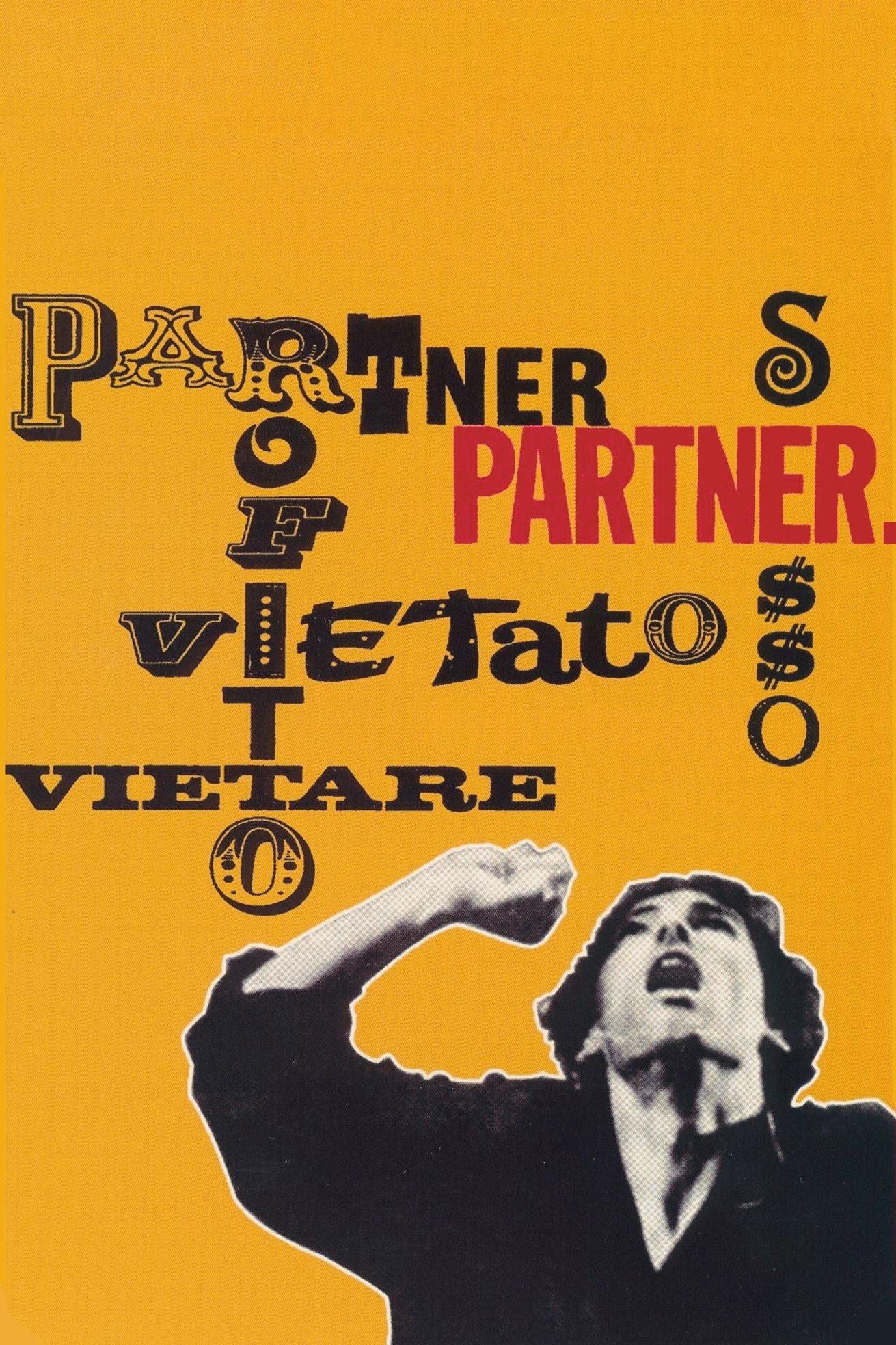
Partner (1968) character relationship network mapped with AI analysis. Explore the connections, alliances, and conflicts between characters.
Characters
Giacobbe I and II
(played by Pierre Clémenti) — protagonist
Giacobbe I and II are the film’s central figures, moving between teaching, role-playing, philosophical debate, and apparent madness. They function like two unstable sides of one personality, experimen...
Salesgirl
(played by Tina Aumont) — protagonist
The Salesgirl is questioned about detergents, television, marriage, children, love, and advertising. Her practical responses reveal how consumer culture can overlap with discipline and ideology, while...
Professor Petrushka
(played by Sergio Tofano) — supporting
Professor Petrushka is an eccentric theatrical theorist who argues that the separation between stage and audience must disappear. He imagines gigantic performers, oversized instruments, improvisation,...
Professor Mozzoni
(played by Giulio Cesare Castello) — supporting
Clara's father
(played by Romano Costa) — supporting
Professor 'Tre Zampe'
(played by Antonio Maestri) — supporting
Clara
(played by Stefania Sandrelli) — minor
Professor
(played by Mario Venturini) — supporting
Student
(played by Alessandro Cane) — supporting
Canonical Relationships
Family, romantic, and professional connections based on plot evidence.
Clara's father → Clara
(father)
Giacobbe I and II → Professor
(Professional Academy Association) — The relationship is institutional rather than individually developed in the plot reference.
The role list identifies Professor as a supporting academy-related character, while Giacobbe I and II are shown teaching and performing at the academy...
Giacobbe I and II → Professor 'Tre Zampe'
(Professional Academy Association) — Their connection is limited to the shared academy context.
The role list identifies Professor 'Tre Zampe' as a professor, and the plot places Giacobbe I and II in an academy environment.
Giacobbe I and II → Professor Mozzoni
(Professional Academy Association) — They are connected through the academy setting, although no specific exchange is described.
The role list places Professor Mozzoni among the academy's named professors, while the plot establishes Giacobbe I and II's continuing activity at the...
Giacobbe I and II → Student
(Power Theatrical Leaders) — The protagonists attempt to mobilize the students into direct public theatre.
Near the end, Giacobbe I and II urge the students to abandon masks and perform in the streets.
Giacobbe I and II → Salesgirl
(Power Interrogator And Subject) — The protagonists impose a performative framework on the Salesgirl's practical answers.
The Salesgirl is questioned about detergents, television, marriage, children, love, and advertising, while Giacobbe I and II transform the interview i...
Giacobbe I and II → Clara
(Romantic Love Interest) — Clara becomes the central emotional focus of the protagonists' romantic and theatrical experiment.
Clara asks one of them to elope and declares her love in a letter.
Giacobbe I and II → Professor Petrushka
(Professional Theatrical Counterpart) — Petrushka's theatrical theory provides an intellectual frame for Giacobbe I and II's performances.
Professor Petrushka argues for the disappearance of the separation between stage and audience, while Giacobbe I and II continue similar theatrical exp...
Story Analysis
A divided theatrical consciousness challenges institutional, romantic, and consumer identities through increasingly extreme performances.
Plot Progression
Theatre Breaks Its Boundaries
— The film opens with a café discussion about abolishing the separation between stage and audience. Professor Petrushka's extravagant ideas establish theatre as direct, physical, and unsettling communic...
Academy Of Divided Selves
— At the academy, Giacobbe I and II mix teaching, political slogans, philosophical questions, and role-playing. Their unstable relationship intensifies through a staged suicide attempt and arguments abo...
Love And Failed Recognition
— Clara's love letter and invitation to elope briefly create emotional possibility. A later aggressive encounter ends in rejection, which the protagonists interpret as instinct defeating theatrical dece...
Consumer Life On Trial
— The Salesgirl is questioned about everyday consumer and family subjects. Her practical responses become evidence in the protagonists' theatrical critique of advertising, consumer culture, and fascist...
The Absent Street Performance
— Giacobbe I and II prepare a spectacular public show about poetry, death, generations, and urban explosion. The students fail to appear, leaving the protagonists furious and convinced that the performa...
Directed by Bernardo Bertolucci
Partner (1968) · 5.8/10 · drama
Content sources
Related entry on
Wikidata
(Q751846), public domain (CC0).
Plot breakdown and analysis on this page are AI-generated from the title's synopsis and metadata.