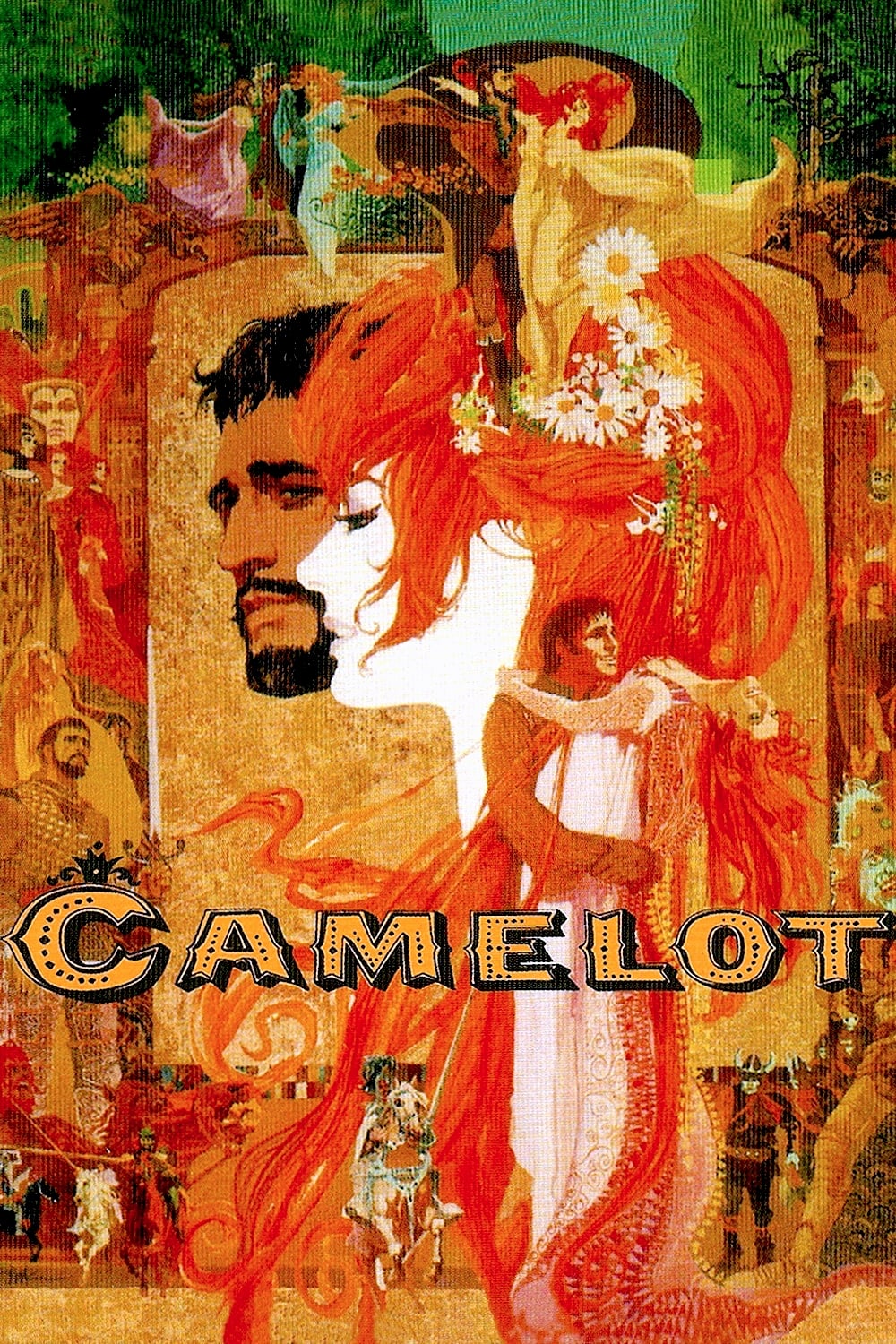
King Arthur (played by Richard Harris) is a protagonist in Camelot.
The legendary King of England who establishes the Round Table and strives for a kingdom ruled by justice rather than might. He marries Guenevere in an arranged union, befriends the French knight Lancelot, and faces a devastating betrayal when his wife and loyal knight fall in love. Bound by his own laws, he sentences Guenevere to death but is relieved when Lancelot rescues her. He ultimately passes his dream to a young boy named Tom before his final battle. Guenevere (played by Vanessa Redgrave) is a protagonist in Camelot.
Arthur's queen, initially entering an arranged marriage with trepidation but gradually falling for his vision of Camelot. She initially resents Lancelot's pride but grows to love him after witnessing his prowess and compassion. Their secret romance causes political turmoil. Bound by Arthur's laws, she is sentenced to death but is dramatically rescued by Lancelot. She later retreats to a convent, ultimately sharing a poignant farewell with both men. Mordred (played by David Hemmings) appears in Camelot.
Arthur's illegitimate son who secretly raises an army in England to overthrow his father. He actively schemes to dismantle the Round Table fellowship by exploiting the romantic scandal between Guenevere and Lancelot. He orchestrates a trap during a hunting trip to catch the lovers in Guenevere's bedchamber, successfully exposing their affair to the court and accelerating the kingdom's downfall. Merlyn (played by Laurence Naismith) appears in Camelot.
Sir Lionel (played by Gary Marshal) appears in Camelot.
Sir Dinadan (played by Anthony Rogers) appears in Camelot.
One of Arthur's knights who participates in a jousting challenge orchestrated by Guenevere to test Lancelot. He is critically wounded by Lancelot during the match, but miraculously recovers after Lancelot lays hands on him and prays for his survival. His healing serves as a pivotal moment that shifts Guenevere's perception of Lancelot.
Camelot (1967) character relationship network mapped with AI analysis. Explore the connections, alliances, and conflicts between characters.
Characters
King Arthur
(played by Richard Harris) — protagonist
The legendary King of England who establishes the Round Table and strives for a kingdom ruled by justice rather than might. He marries Guenevere in an arranged union, befriends the French knight Lance...
Guenevere
(played by Vanessa Redgrave) — protagonist
Arthur's queen, initially entering an arranged marriage with trepidation but gradually falling for his vision of Camelot. She initially resents Lancelot's pride but grows to love him after witnessing...
Mordred
(played by David Hemmings) — supporting
Arthur's illegitimate son who secretly raises an army in England to overthrow his father. He actively schemes to dismantle the Round Table fellowship by exploiting the romantic scandal between Gueneve...
Merlyn
(played by Laurence Naismith) — supporting
Sir Lionel
(played by Gary Marshal) — supporting
Sir Dinadan
(played by Anthony Rogers) — supporting
One of Arthur's knights who participates in a jousting challenge orchestrated by Guenevere to test Lancelot. He is critically wounded by Lancelot during the match, but miraculously recovers after Lanc...
Canonical Relationships
Family, romantic, and professional connections based on plot evidence.
King Arthur → Guenevere
(Romantic Husband)
The plot states that Arthur and Guenevere enter an arranged marriage and later develop a deeply conflicted relationship.
King Arthur → Mordred
(Family Father)
Mordred is explicitly described as Arthur's illegitimate son and raises an army against him.
Story Dynamics
Alliances, conflicts, and narrative interactions that evolve throughout the story.
Sir Dinadan → Sir Lionel
(related)
Sir Lionel → Merlyn
(related)
Sir Lionel → King Arthur
(related)
Mordred → Guenevere
(Conflict Political Adversary)
Mordred exploits the scandal involving Guenevere and the French knight, arranging circumstances that lead to her arrest.
Story Analysis
A king's idealistic vision collapses under forbidden love, political betrayal, and the conflict between personal feeling and public law.