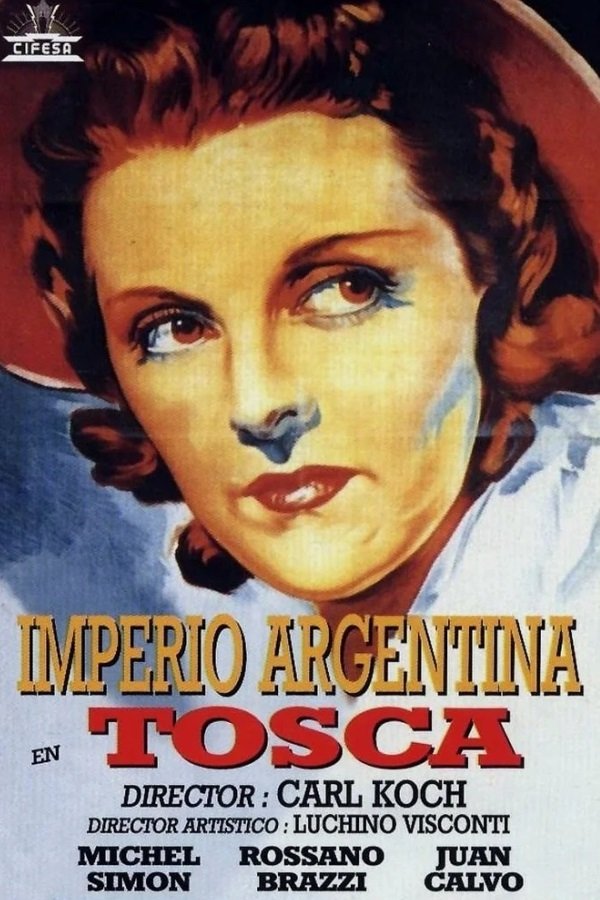
Tosca (1941) character relationship network mapped with AI analysis. Explore the connections, alliances, and conflicts between characters.
Characters
Floria Tosca
(played by Imperio Argentina) — protagonist
The titular character, a celebrated opera singer and the passionate lover of Mario Cavaradossi. She is the central figure of the drama, whose jealousy is manipulated by Scarpia and who ultimately take...
Il barone Scarpia
(played by Michel Simon) — protagonist
The villainous chief of police, a ruthless and manipulative figure who uses his power to pursue Tosca and orchestrate the downfall of her lover, Mario Cavaradossi.
Mario Cavaradossi
(played by Rossano Brazzi) — supporting
A painter and Tosca's lover, who becomes a political fugitive for aiding Angelotti. His arrest and torture by Scarpia drive the central conflict of the story.
La marchesa Attavanti
(played by Carla Candiani) — supporting
A noblewoman whose portrait is painted by Cavaradossi and whose resemblance to Tosca fuels the latter's jealousy. She is connected to the political intrigue involving Angelotti.
La regina di Napoli
(played by Olga Vittoria Gentilli) — supporting
The Queen of Naples, a minor character who appears in the royal court setting, representing the monarchical authority that Scarpia serves.
Angelotti
(played by Adriano Rimoldi) — supporting
A political prisoner who escapes and seeks refuge with Cavaradossi, setting the plot in motion. His presence leads to Cavaradossi's arrest.
Sciarrone
(played by Nicolás D. Perchicot) — supporting
A police agent or subordinate of Scarpia, who carries out orders and reports on the pursuit of Angelotti and the arrest of Cavaradossi.
Il pittore di corte
(played by Nicola Maldacea) — supporting
The court painter, a minor character associated with the royal court and possibly involved in the artistic circles of the story.
Canonical Relationships
Family, romantic, and professional connections based on plot evidence.
Mario Cavaradossi → Il pittore di corte
(Professional Colleague) — Both are court painters
Mario Cavaradossi → La marchesa Attavanti
(Professional Subject) — Paints her portrait
Il barone Scarpia → La regina di Napoli
(Professional Subordinate) — Serves the Queen of Naples
Il barone Scarpia → Sciarrone
(Professional Commander) — Chief of police commands his officer
Il barone Scarpia → Angelotti
(Professional Hunting) — Police chief pursuing the fugitive
Floria Tosca → Mario Cavaradossi
(Romantic Lovers) — Opera singer in love with the painter
Story Dynamics
Alliances, conflicts, and narrative interactions that evolve throughout the story.
Il barone Scarpia → La marchesa Attavanti
(Conflict Rival) — Both interested in Mario's affection
Mario Cavaradossi → Il barone Scarpia
(Conflict Prisoner) — Arrested and tortured by Scarpia
Mario Cavaradossi → Angelotti
(Alliance Helper) — Painter helps the political refugee
Floria Tosca → Il barone Scarpia
(Conflict Obsessed Pursuer) — Chief of police who desires Tosca
Story Analysis
The supplied reference confirms the film's identity, adaptation lineage, production context, and international release history, but does not provide story events or character interactions.
Plot Progression
Identifying the Adaptation
— The reference identifies Tosca as a 1941 Italian historical drama. It also establishes its connection to Sardou's play and the later operatic tradition.
Shaping the Production
— The production information names the director and principal cast. These details confirm the film's creative and performance framework.
Filming Rome
— The film was made at the Scalera Studios and also used locations around Rome. Its sets were designed by Gustav Abel.
Reaching International Audiences
— The film received an American release under the title The Story of Tosca. It later reached Spain in 1943 through Cifesa.