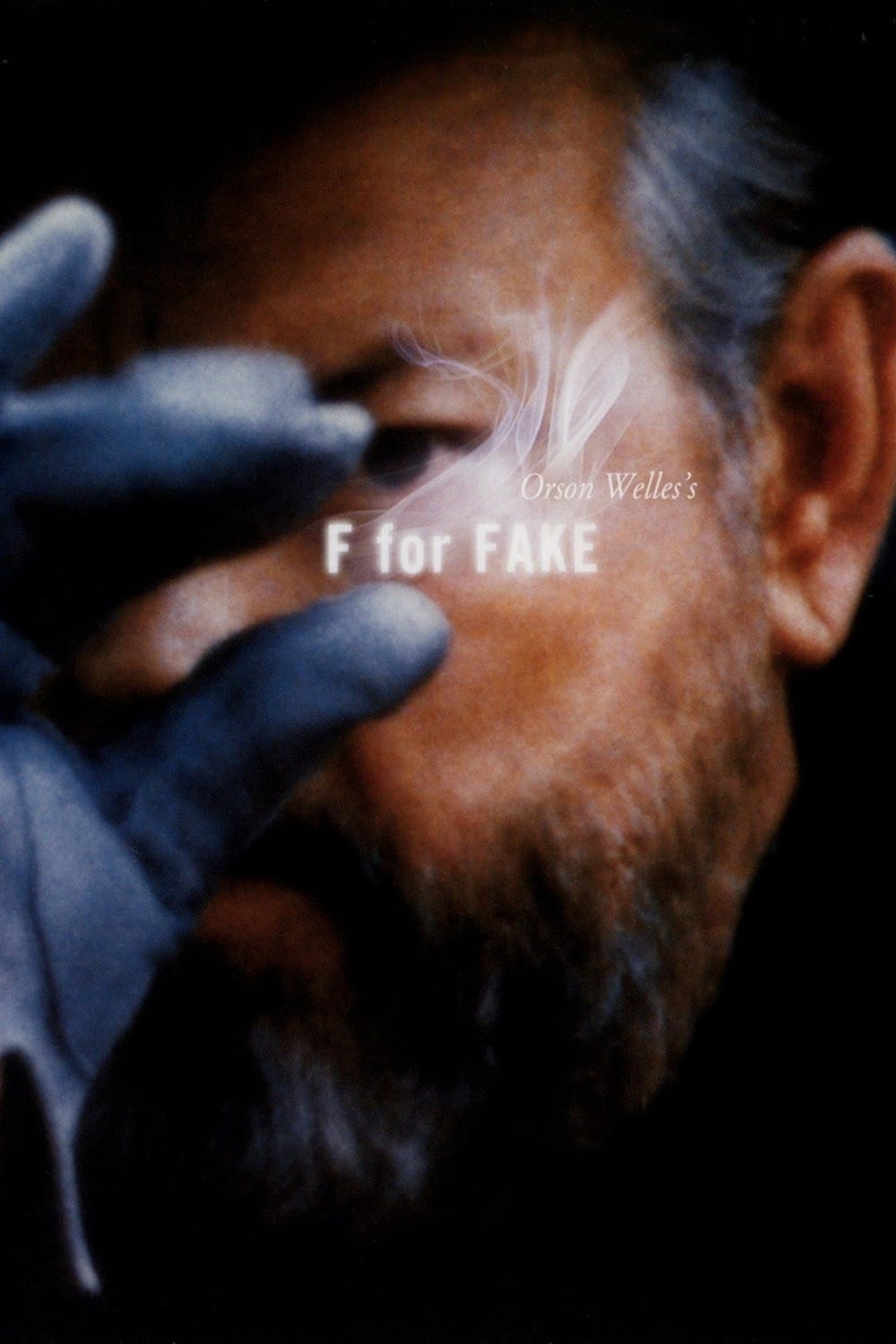
Plot Analysis Summary
The film explores how forgery, performance, authorship, and documentary truth overlap until deception becomes a way to reveal reality.
Story Structure — 5 Plot Phases
Promises of Truth
Welles opens with magic and declares that the coming hour will be based on fact. The girl-watching footage immediately complicates that promise by exposing the mechanics of observation.
Key Events
-
Opening Magic Performance — Welles performs magic tricks for children while promising that the film will rely on solid fact. Characters: Self
Location: A public setting
-
The Girl-Watching Experiment — Kodar walks through a street while men watch her, unaware that they are being filmed. Characters: Self
Location: A city street
-
Elmyr Enters the Story — The film introduces Elmyr de Hory, an art forger celebrated by European society. Characters: Self
Location: Ibiza
-
Ibiza Dinner Party — De Hory hosts a dinner party while avoiding a direct answer about his guilt. Characters: Self
Location: De Hory's home in Ibiza
Forgers and Believers
The film examines de Hory, Irving, forged paintings, and the institutions that authenticate them. Welles expands the question from individual fraud to collective credulity.
Key Events
-
The Fake Biography — The film discusses Irving's biography of de Hory and his later fake authorized biography of Hughes. Characters: Self
Location: Film interview footage
-
Forgery and Irony — Welles emphasizes the irony of Irving judging de Hory's forgery while creating a related deception. Characters: Self
Location: Interview settings
-
Questioning Art Experts — The film asks whether dealers and appraisers are also fake when they accept forged works. Characters: Self
Location: Interview settings
-
The Hughes Hoax — Irving's alleged contacts with Hughes and stories about Hughes are presented as uncertain and possibly invented. Characters: Self
Location: Interview footage
-
Reichenbach's Testimony — Reichenbach describes receiving questionable paintings from de Hory and dealers ignoring warning signs. Characters: Self
Location: Interview setting
Welles Among the Fakes
Welles admits his own history of theatrical and broadcast deception. The discussion of de Hory's career and legal escape deepens the film's uncertainty about authorship and responsibility.
Key Events
-
The Borrowed House — Welles notes that de Hory does not own his home because an art dealer provides it. Characters: Self
Location: Ibiza
-
Welles Uses Fakery — Welles recounts falsely claiming to be a famous actor and using fake news in The War of the Worlds. Characters: Self
Location: Ireland and radio studio
-
The Citizen Kane Coincidence — Welles notes that Citizen Kane was initially planned as a fictionalized account of Hughes's life. Characters: Self
Location: Film commentary
-
De Hory's Early Poverty — Irving describes de Hory's poverty, forged paintings, and repeated relocations to stay ahead of the law. Characters: Self
Location: The United States
-
The Unprosecuted Forger — De Hory avoids prosecution because witnesses to the actual forging are absent and the scandal would be extensive. Characters: Self
Location: Ibiza
The Elaborate Invention
Kodar's apparent Picasso story develops into a complete tale of imitation, artistic pride, and destroyed evidence. The narrative appears to offer a final example of creative forgery.
Key Events
-
The Missing Signature — Welles questions whether an artwork needs a signature and compares forgery with the anonymous creators of Chartres. Characters: Self
Location: Chartres Cathedral
-
Kodar's Picasso Story — Kodar's supposed story begins with Picasso painting twenty-two works while using her as a model. Characters: Self
Location: A village near Picasso's holiday location
-
The Exhibition Deception — Picasso supposedly discovers that the celebrated exhibition consists entirely of forgeries. Characters: Self
Location: An art exhibition
-
The Forged Picasso Period — In a verbal reenactment, the forger proudly claims to have invented a new Picasso period. Characters: Self
Location: The grandfather's home
Truth Through Deception
Welles reveals that the final story was fabricated and acknowledges that the promised hour of truth has ended. The film closes by connecting artistic falsehood with a deeper form of truth.
Key Events
-
The Story Is Exposed — Welles reveals that Kodar's story, her grandfather, and Picasso encounter were invented. Characters: Self
Location: The film's narrative space
-
Art and Truth — Welles apologizes, invokes Picasso's idea that art is a lie revealing truth, and says good evening. Characters: Self
Location: The film's closing address