Story Structure — 4 Plot Phases
Calibration and Dawn
The film opens with technical preparation and a blank white screen. As the camera adjusts for night filming, the initial daylight slowly fades, marking the beginning of the temporal shift.
Key Events
-
Camera Calibration Phase — Camera set for night filming, screen blank white.
Location: Rockefeller Foundation Office
-
Initial Film Loading — Magazines changed, camera begins recording.
Location: Rockefeller Foundation Office
-
Sunset Begins — Natural light fades almost imperceptibly.
Location: Empire State Building Exterior
-
Building Emerges — Structure silhouette becomes visible against sky.
Location: Empire State Building Exterior
Sunset and Emergence
Natural light continues to recede, allowing the Empire State Building to gradually emerge from the fading sky. Architectural details become sharper as the environment transitions toward evening.
Key Events
-
Building Emerges — Structure silhouette becomes visible against sky.
Location: Empire State Building Exterior
-
Detail Clarification — Architectural features sharpen as daylight shifts.
Location: Empire State Building Exterior
-
Enveloped in Darkness — Nightfall fully covers the building structure.
Location: Empire State Building Exterior
Nightfall and Illumination
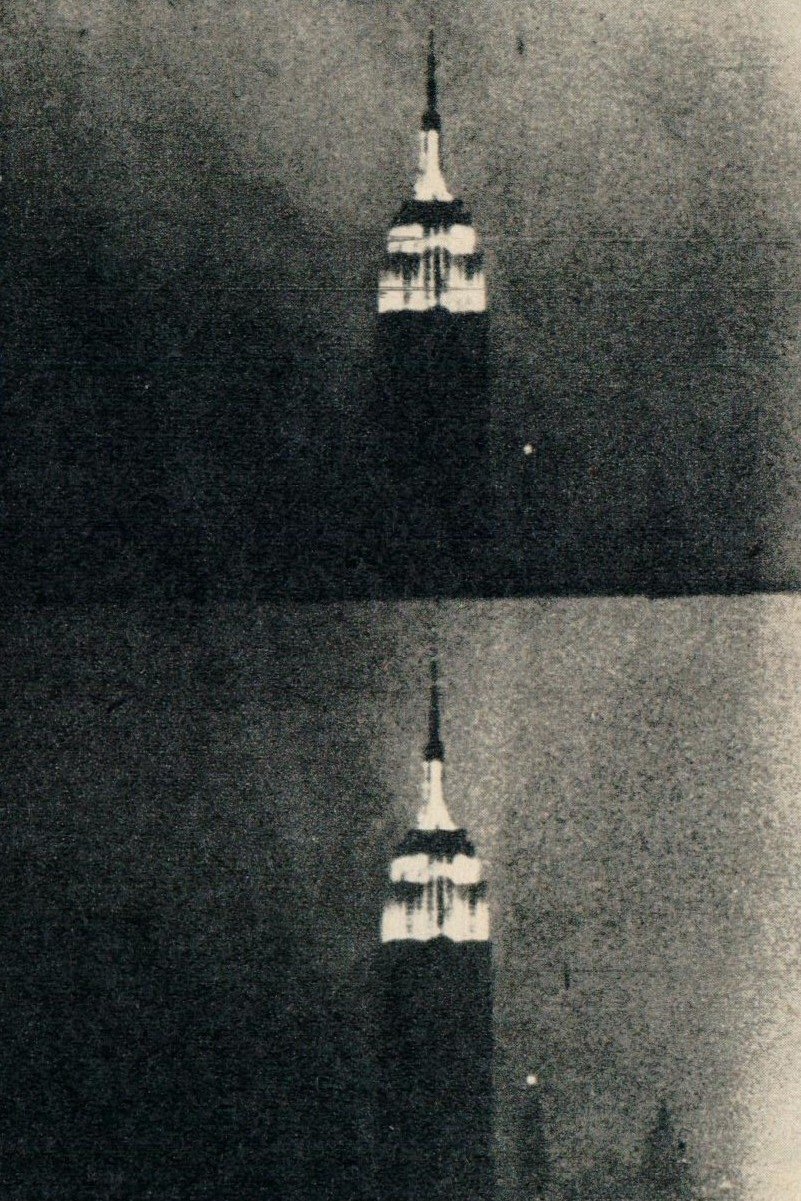
Darkness fully envelops the structure, prompting the activation of artificial floodlights. The building glows brightly while surrounding city lights and background beacons create a rhythmic urban pulse.
Key Events
-
Floodlights Activation — Electric lights switch on, upper levels glow.
Location: Empire State Building Exterior
-
Spire Illumination — Top spire catches light, standing out clearly.
Location: Empire State Building Exterior
-
Window Lights Flicker — Surrounding building windows activate randomly.
Location: Empire State Building Exterior
-
Beacon Rhythm Starts — Background tower flashes every fifteen minutes.
Location: Metropolitan Life Tower
-
Hourly Time Display — Beacon signals current time of day hourly.
Location: Metropolitan Life Tower
Darkness and Reflection
Main illumination cuts out, plunging the scene into near total darkness. The only visual shifts come from the office lights reflecting the filming crew, including the director, before the film ends.
Key Events
-
Hourly Time Display — Beacon signals current time of day hourly.
Location: Metropolitan Life Tower
-
Floodlights Extinguished — Main illumination cuts, building returns to dark.
Location: Empire State Building Exterior
-
Total Darkness Phase — Screen approaches near total blackness.
Location: Empire State Building Exterior
-
Crew Window Reflections — Reflections visible in office windows.
Location: Rockefeller Foundation Office
-
Warhol Presence Revealed — Director visible among crew reflections.
Location: Rockefeller Foundation Office
-
Technical Setup Notes — Lights left on during magazine changes.
Location: Rockefeller Foundation Office
-
Slow Motion Effect — 24fps footage projected at 16fps.
Location: Rockefeller Foundation Office
-
Runtime Extension — Six and a half hours stretches to eight.
Location: Rockefeller Foundation Office
-
Stationary Composition — Fixed camera angle maintained throughout.
Location: Empire State Building Exterior
-
Final Frame Hold — Film concludes on static architectural image.
Location: Empire State Building Exterior
Filmed by Jonas Mekas from the 44th floor of the Time-Life Building, “Empire” explores the passage of time without the use of characters or a traditional narrative. The film, that consists of one stationary shot of the Empire State Building, was made from standard 1,200-foot rolls of 16mm film with a more than eight-hour runtime.