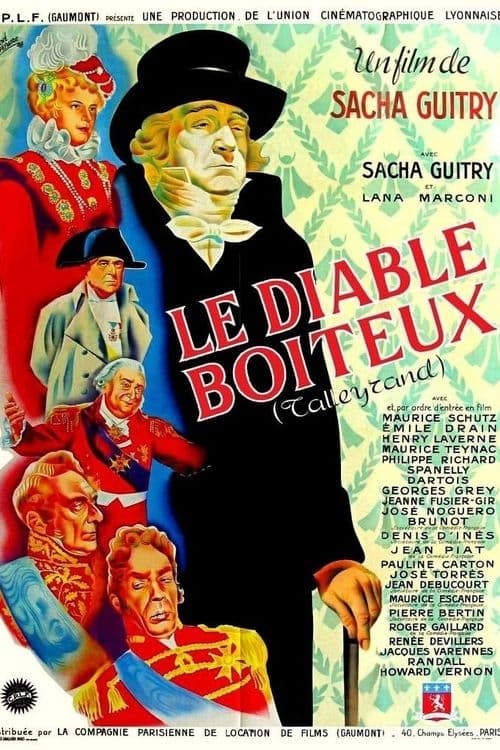
The Devil Who Limped (1948) — AI Story Visualization
Plot Analysis Summary
A biographical exploration of Talleyrand's political survival and personal duality across five French regimes.
Story Structure — 4 Plot Phases
The Mirror of History
The film opens with a self-aware sequence in 1948 Paris, establishing its biographical nature through bookstore displays and mise en abyme.
Key Events
Opening Sequence — The film begins with a self-referential opening sequence. Characters: TalleyrandLocation: 1948 Paris
Birthplace Depiction — Shows the physical location of his origins. Characters: TalleyrandLocation: Talleyrand's Birthplace
Bookstore Window — His biographies are displayed, creating a mise en abyme. Characters: TalleyrandLocation: Paris Bookstore
Biography Introduction — Establishes the biographical framework of the film. Characters: TalleyrandLocation: Narrative Space
Le Diable boiteux — A key biographical text displayed in the opening. Characters: TalleyrandLocation: Bookstore
Navigating the Turbulent Century
Talleyrand's political career is traced across five major French regimes, highlighting his diplomatic survival and adaptability.
Key Events
Political Career Sketch — Outlines his extensive public political life. Characters: TalleyrandLocation: French Courts
Five Regimes Navigation — Tracks his survival across five distinct political eras. Characters: TalleyrandLocation: France
Diplomatic Service — Highlights his half-century career as a diplomat. Characters: TalleyrandLocation: Diplomatic Posts
Regime Transitions — Details the shift from monarchy to constitutional rule. Characters: TalleyrandLocation: France
The Private Man Behind the Statesman
The narrative shifts to his personal life, exploring his reputation as a womanizer and weaving together dozens of life anecdotes.
Key Events
Diplomatic Service — Highlights his half-century career as a diplomat. Characters: TalleyrandLocation: Diplomatic Posts
Priesthood Origins — References his early background as a French priest. Characters: TalleyrandLocation: Church
Private Life Exploration — Shifts focus to his reputation as a womanizer. Characters: TalleyrandLocation: Private Residences
Anecdote Compilation — Weaves together a dozen life episodes and anecdotes. Characters: TalleyrandLocation: Narrative Space
Character Study — Deepens the psychological portrait through anecdotes. Characters: TalleyrandLocation: Narrative Space
Echoes of a Legacy
Historical quotes and thematic reflections converge, culminating in a resolution that ties his 18th-century life to 1948 cultural memory.
Key Events
Anecdote Compilation — Weaves together a dozen life episodes and anecdotes. Characters: TalleyrandLocation: Narrative Space
Historical Quotes Integration — Dialogues are enriched with quotes from depicted figures. Characters: TalleyrandLocation: Dialogue Scenes
Public vs Private Duality — Juxtaposes his political maneuvers with personal romances. Characters: TalleyrandLocation: Contrasting Settings
Title Etymology — Explains the origin of his nickname and its literary parallels. Characters: TalleyrandLocation: Narrative Space
Cinematic Reflection — Returns to the contemporary setting to close the loop. Characters: TalleyrandLocation: 1948 Paris
Director's Intent — Guitry's explanation of the dialogue and quote strategy. Characters: TalleyrandLocation: Behind the Scenes
Historical Legacy — Concludes with his enduring place in French history. Characters: TalleyrandLocation: Historical Record
Narrative Closure — Finalizes the biographical arc and thematic reflection. Characters: TalleyrandLocation: 1948 Paris
Story Breakdown
Cinematic Framing — Establishes the film's self-referential and biographical structure.
1948 Paris Context — Sets the contemporary backdrop for the historical narrative.
Mise en abyme Device — Uses bookstore displays to reflect the film's meta-narrative.
Political Survival — Tracks Talleyrand's adaptation across shifting French governments.
Five Regime Navigation — Details his service under monarchy, revolution, and empire.
Diplomatic Mastery — Highlights his half-century career and strategic alliances.
Personal Duality — Explores the contrast between his public duties and private desires.
Womanizer Reputation — Examines his romantic pursuits and private scandals.
Priesthood Origins — References his early religious background and career shift.
Narrative Structure — Organizes the biography through episodic anecdotes and quotes.
Anecdotal Compilation — Weaves together dozen life episodes for character study.
Historical Quotes — Enriches dialogues with authentic historical voices.
Thematic Resonance — Connects Talleyrand's life to broader cultural and literary themes.
Title Etymology — Links his nickname to Asmodeus and Lord Byron.
Legacy Reflection — Positions him as an enduring figure in French history.
Director's Vision — Sacha Guitry's approach to biographical storytelling.
Actor Portrayal — Guitry's dual role as director and lead actor.
Dialogue Strategy — Peppering scenes with historical quotes for authenticity.
The film is a 125-minute, black-and-white biography of French priest and diplomat Charles Maurice de Talleyrand-Périgord (1754–1838), who served for 50 years under five different French regimes: the Absolute Monarchy, the Revolution, the Consulate, the Empire, and the Constitutional Monarchy. Its title comes from one of the main historical nicknames for Talleyrand, that he shares with demon king Asmodeus and English poet Lord Byron.