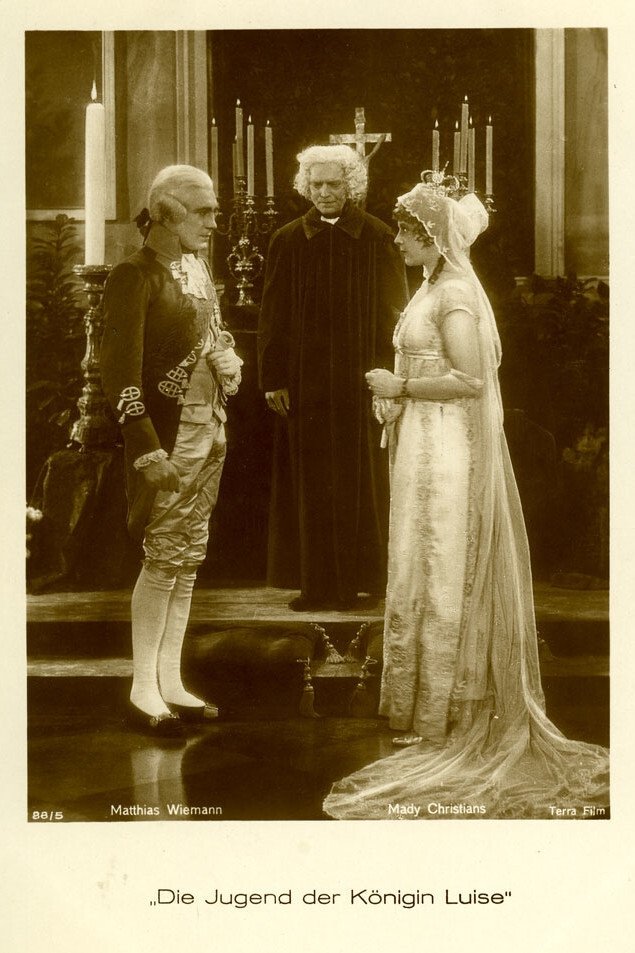
A silent historical biopic tracing the life of Louise of Mecklenburg-Strelitz and her marriage to Prussian monarch Frederick William III.
The film is introduced as a German silent historical epic directed by Karl Grune. Production begins at Terra Studios with elaborate set designs by Hans Jacoby and principal casting.
The narrative establishes the central relationship between Louise and Frederick William III. Their marriage forms the core of the biographical focus within the Prussian court.
The film portrays the short life of Louise against the backdrop of Prussian monarchy. Political and personal contexts are woven through silent cinematic storytelling.
The two-part structure concludes with a theatrical release across late 1927 and early 1928. The film establishes its legacy as the start of Grune's historical epic series.
The young Crown Princess Luise of Mecklenburg-Strelitz grows up sheltered in the North German countryside in the late 18th century and develops into a bit of a rebel. She struggles to come to terms with the rules of etiquette at court; her actions are often spontaneous and driven by emotion. Thus, she resists accepting her father’s mistress and future wife. During a ball, she snubs her future stepmother and even has the audacity to ask the orchestra to play a waltz—a dance considered deeply improper at the time.
Karl Grune
Rating: 8/10 (1 votes)
Plot analysis generated from content on Wikipedia, licensed under CC BY-SA 4.0.
Related entry on Wikidata (Q14949914), public domain (CC0).