The reference presents the opera's literary origins, Parisian setting, composition history, premiere, and long-term recording legacy.
Story Structure — 4 Plot Phases
Origins of the Bohemian Story
The opera draws on a literary work about bohemian life. Its setting is Paris around 1830, where a poor seamstress and artist friends define the social world.
Key Events
Opera Composition Begins — The opera was composed between 1893 and 1895.
Location: Italy
Literary Source Established — The story is based on a nineteenth-century work about bohemian life.
Location: Paris
Paris Around 1830 — The narrative setting is Paris around 1830.
Location: Paris
Bohemian Lifestyle Introduced — The story presents the bohemian lifestyle of poor artists and their companions.
Location: Paris
Building the Opera
The composition was developed between 1893 and 1895 and organized into four acts. An Italian libretto completed the operatic form.
Key Events
Seamstress Community Portrayed — A poor seamstress and her artist friends form the central social environment.
Location: Paris
Four Act Structure — The work is structured as an opera in four acts.
Location: Opera Stage
Italian Libretto Completed — An Italian libretto was created for the composition.
Location: Italy
World Premiere Announced — The world premiere took place on 1 February 1896.
Location: Turin
The Turin Premiere
The world premiere occurred in Turin on 1 February 1896 at the Teatro Regio. The performance was led by a twenty-eight-year-old conductor.
Key Events
World Premiere Announced — The world premiere took place on 1 February 1896.
Location: Turin
Teatro Regio Premiere — The first performance was presented at the Teatro Regio in Turin.
Location: Teatro Regio, Turin
Original Conducting Debut — The premiere was conducted by a twenty-eight-year-old conductor.
Location: Teatro Regio, Turin
Repertory Recognition — The opera became part of the standard Italian opera repertory.
Location: Opera Houses Worldwide
A Lasting Performance Legacy
The opera entered the standard Italian repertory and became widely performed around the world. A later commemorative radio performance was preserved through commercial recordings.
Key Events
Repertory Recognition — The opera became part of the standard Italian opera repertory.
Location: Opera Houses Worldwide
Global Performance Tradition — It became one of the most frequently performed operas worldwide.
Location: Opera Houses Worldwide
Commemorative Radio Performance — Fifty years after the premiere, a commemorative performance was broadcast on radio.
Location: Radio Broadcast Studio
NBC Symphony Recording — The commemorative performance was made with the NBC Symphony Orchestra.
Location: Radio Broadcast Studio
Commercial Recording Release — The recording was later released on vinyl, tape, and compact disc.
Location: Recording Archive
Story Breakdown
Literary Foundations — The opera is based on an earlier work portraying bohemian life.
Bohemian Source — The narrative is based on a nineteenth-century literary work.
Adapted Libretto — The source material was transformed into an Italian operatic libretto.
Parisian World — The story is located in Paris around 1830 and focuses on a bohemian social environment.
Paris Around 1830 — Paris provides the historical and geographic setting.
Artist Friends — A group of artist friends forms part of the central community.
Central Social Life — The reference highlights poverty, creative companionship, and the life of a seamstress.
Poor Seamstress — A poor seamstress is identified as a central figure in the story.
Bohemian Lifestyle — The opera depicts the lifestyle associated with the bohemian community.
Operatic Construction — The work was composed during the 1890s and arranged in four acts.
Four Act Form — The opera consists of four acts.
Composition Period — The composition process lasted from 1893 to 1895.
Turin Premiere — The first performance established the work publicly at a major Turin opera venue.
Premiere Date — The world premiere took place on 1 February 1896.
Teatro Regio — The premiere was held at the Teatro Regio in Turin.
Enduring Legacy — The opera became internationally important through repertory performances and preserved recordings.
Standard Repertory — The work became part of the standard Italian opera repertory.
Radio Recording — A 1946 commemorative radio performance was later released in several formats.
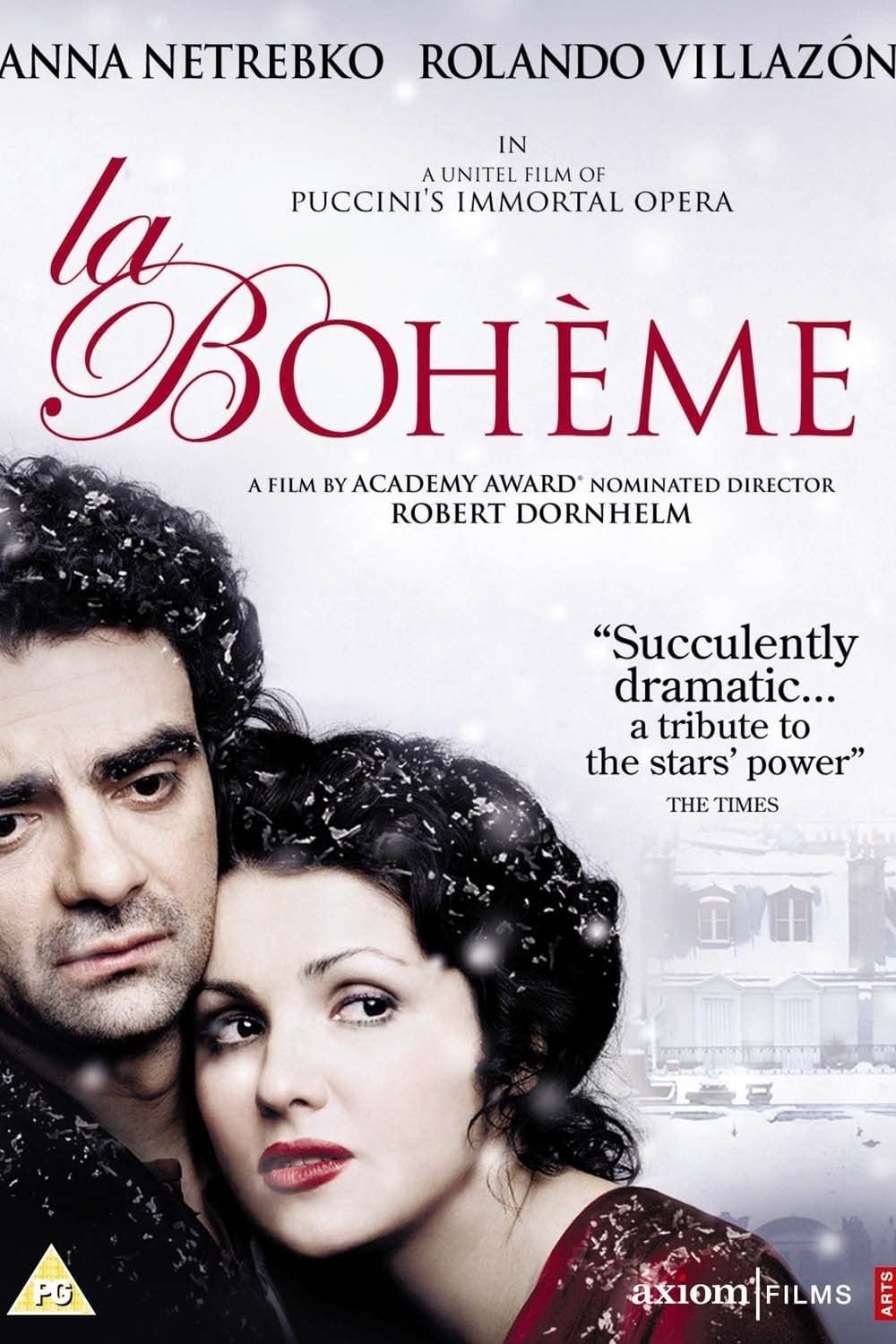
Giacomo Puccini's immortal opera, in a high budget feature-film version directed by Academy Award nominee Robert Dornhelm, stars opera's 'Golden Couple', Rolando Villazon and Anna Netrebko as the protagonists, Rodolfo and Mimi. The chemistry between them is electric, unrivalled in the theatre today. Russian soprano Anna Netrebko is not only beautiful but has a marvelous voice and technique; Mexican tenor Rolando Villazon, has a wonderful voice and an incredible charisma. The director not only wanted to remain steadfastly faithful to Puccini's design but also document two of the leading singers of the modern age rather than embarking on a 'trendy' contemporary re-creation.