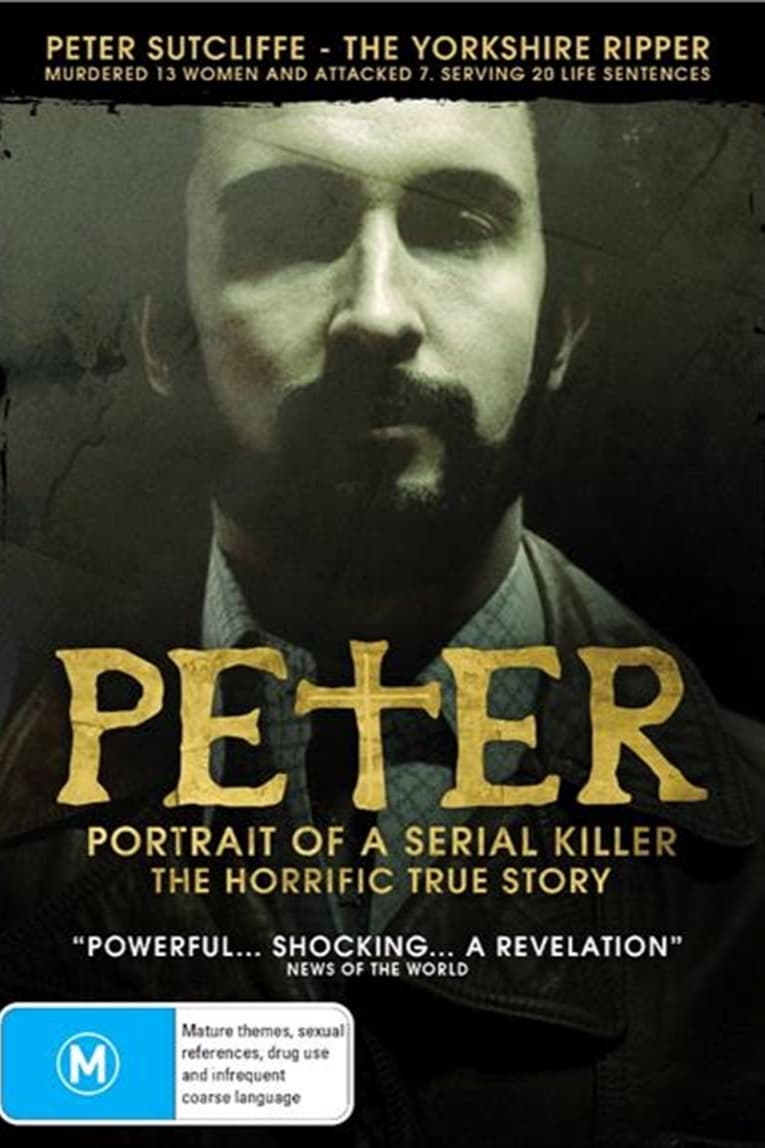
Peter (2011) character relationship network mapped with AI analysis. Explore the connections, alliances, and conflicts between characters.
Characters
Peter Sutcliffe
(played by Walt Kissack) — protagonist
The central subject of the film, a serial killer responsible for the sadistic murders of 13 women. The narrative chronicles his troubled childhood, his ongoing psychological treatment, and his diagnos...
Dr Spencer
(played by Gary Sharkey) — protagonist
A psychiatrist or medical professional involved in the psychological evaluation and treatment of the central figure.
Aleck
(played by Adam Lewis) — supporting
A secondary character appearing in the film's portrayal of the case and its surrounding events.
Martin Clement
(played by Nicholas Ball) — supporting
A supporting character contributing to the narrative's exploration of the killer's background or the investigation.
Jan
(played by Tracey Wilkinson) — supporting
A supporting figure, likely one of the female victims mentioned in the case or a person closely affected by the crimes.
Brian Jones
(played by Graham Hornsby) — supporting
A supporting character featured in the film's depiction of the Yorkshire Ripper case and its psychological dimensions.
Pathologist Dr Burns
(played by Grahame Edwards) — supporting
A forensic medical expert analyzing evidence and casualties related to the serial murders.
Susannah Chapman
(played by Julie Hoult) — minor
A supporting figure connected to the investigation or the victims, possibly another casualty of the serial killer.
Detective Lambton
(played by Matt Sutton) — minor
A law enforcement officer leading or participating in the investigation of the serial killings.
Canonical Relationships
Family, romantic, and professional connections based on plot evidence.
Dr Spencer → Pathologist Dr Burns
(Professional Clinical & Forensic Experts) — Both professionals collaborate to analyze Peter's mental state and crime patterns.
Detective Lambton → Pathologist Dr Burns
(Professional Investigator & Expert) — Lambton relies on Dr Burns' pathological findings to build the criminal case.
Peter Sutcliffe → Pathologist Dr Burns
(Professional Criminal & Medical Examiner) — Dr Burns analyzes forensic evidence and autopsy reports from Peter's murders.
Peter Sutcliffe → Dr Spencer
(Professional Psychiatrist & Patient) — Dr Spencer conducts ongoing clinical treatment and psychological assessment on Peter.
Story Dynamics
Alliances, conflicts, and narrative interactions that evolve throughout the story.
Peter Sutcliffe → Martin Clement
(Social Subject & Associate) — Martin Clement provides contextual insights into Peter's life and behavior.
Peter Sutcliffe → Aleck
(Social Subject & Associate) — Aleck is a supporting figure connected to Peter's social circle or past environment.
Peter Sutcliffe → Brian Jones
(Conflict Perpetrator & Victim) — Brian Jones is one of the thirteen women murdered during Peter's killing spree.
Peter Sutcliffe → Jan
(Conflict Perpetrator & Victim) — Jan is one of the thirteen women targeted and killed by Peter.
Peter Sutcliffe → Susannah Chapman
(Conflict Perpetrator & Victim) — Susannah Chapman is one of the thirteen women brutally murdered by Peter.
Peter Sutcliffe → Detective Lambton
(Conflict Perpetrator & Investigator) — Lambton leads the police manhunt to track and apprehend Peter for his crimes.
Story Analysis
The film examines a notorious serial killer through biography, murder history, archive evidence, psychiatric treatment, and unresolved moral interpretation.
Plot Progression
A Portrait Built From Evidence
— The film establishes an uncompromising true-crime portrait through performances and rare archive material. It then turns toward the subject's childhood and psychological background.
The Murderous Pattern
— The account details the sadistic murders of thirteen women and places them within the subject's public notoriety. Archive material intensifies the disturbing historical record.
Illness Under Examination
— Ongoing psychological treatment becomes central to the film's investigation. Psychiatric claims introduce a possible explanation for the subject's actions.
Judgment Without Closure
— The film contrasts paranoid schizophrenia with the belief that the subject is simply evil. It leaves viewers to make their own judgment.
Directed by Skip Kite
Content sources
Plot breakdown and analysis on this page are AI-generated from the title's synopsis and metadata.