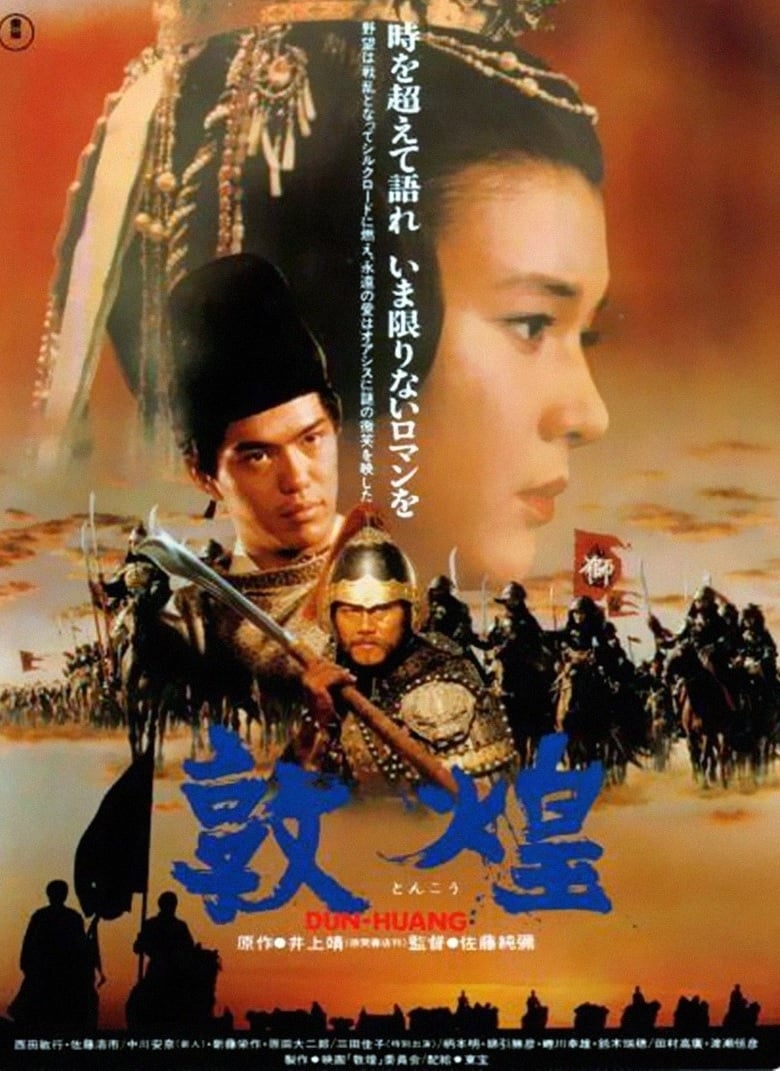
The supplied reference presents a historical epic centered on Dunhuang, the Silk Road, and the manuscript heritage of the Mogao Caves.
Story Structure — 4 Plot Phases
Identifying the Historical Epic
The reference establishes the film's Japanese production, alternate title, director, and historical-drama classification. It also identifies the adaptation's literary source.
Key Events
Film Identified as Dun-Huang — The reference identifies the film as a 1988 Japanese epic historical drama also known as Dun-Huang.
Dunhuang on the Silk Road — The story is situated in Dunhuang, Western China, along the Silk Road.
Location: Dunhuang, Western China
Dunhuang Along the Silk Road
The supplied material places the narrative in Dunhuang, Western China, along the Silk Road. The period is identified as the eleventh-century Song dynasty.
Key Events
Dunhuang on the Silk Road — The story is situated in Dunhuang, Western China, along the Silk Road.
Location: Dunhuang, Western China
Song Dynasty Setting — The supplied reference places the historical setting in the eleventh-century Song dynasty.
Location: Western China
Mogao Caves — The Mogao Caves are identified as the central location connected to the narrative.
Location: Mogao Caves, Dunhuang
The Manuscript Sanctuary
The Mogao Caves are presented as the central location. Their importance derives from the Buddhist manuscript trove associated with them.
Key Events
Mogao Caves — The Mogao Caves are identified as the central location connected to the narrative.
Location: Mogao Caves, Dunhuang
Buddhist Manuscript Trove — The reference describes the caves as a trove of Buddhist manuscripts.
Location: Mogao Caves
Novel Adaptation — The film is stated to be adapted from Yasushi Inoue's 1959 novel Tun-Huang.
Release and Cultural Reception
The reference records the film's release in Japan and China on June 25, 1988. It also notes its Best Film recognition and Japanese box-office ranking.
Key Events
Japanese and Chinese Release — The reference states that the film was released in Japan and China on June 25, 1988.
Location: Japan and China
Japan Academy Recognition — The film was chosen as Best Film at the twelfth Japan Academy Prize ceremony.
Location: Japan
Historical Box Office Ranking — The supplied reference places the film forty-eighth among Japanese films by all-time gross.
Location: Japan
Story Breakdown
Film Identity — The reference identifies the production and its alternate title.
Japanese Epic Drama — The film is described as a 1988 Japanese epic historical drama.
Alternate Title — The film is also identified as Dun-Huang.
Historical Setting — The supplied material specifies the historical period and broad geographic context.
Song Dynasty — The setting is placed in the eleventh-century Song dynasty.
Western China — The narrative location is identified as Western China.
Silk Road Context — Dunhuang is connected to the broader Silk Road setting.
Dunhuang — Dunhuang is identified as the principal regional setting.
Trade Route — The reference explicitly situates Dunhuang along the Silk Road.
Mogao Caves — The caves form the central cultural and geographic focus described in the reference.
Cave Complex — The Mogao Caves are named as the key location.
Manuscript Trove — The caves are associated with a Buddhist manuscript trove.
Literary Foundation — The film's source and adaptation history are explicitly provided.
Yasushi Inoue Novel — The film was adapted from Yasushi Inoue's 1959 novel Tun-Huang.
Screen Adaptation — The reference frames the film as a cinematic adaptation of that novel.
Release and Legacy — The supplied information records the film's release and later recognition.
1988 Release — The film was released in Japan and China on June 25, 1988.
Best Film Award — It was chosen as Best Film at the twelfth Japan Academy Prize ceremony.
In 1026, students in western China are shanghaied into the forces of crown prince Li Yuanhao of Xi Xia, who wants to control the length of the Silk Road. One student is Zhao Xingde, who becomes the favorite of his commander, Zhu Wangli. While sacking a fortress, Xingde discovers Tsurpia, princess of the Uighur. He hides her; they fall in love. When he's sent away to study Xixian, he leaves Tsurpia in Zhu's care, but returns to find her engaged to Li. Tragedy follows, and he and Zhu enter a pact to take revenge when Li arrives at Dun-Huang, the region's seat of learning and culture. Against overwhelming odds, they find a surprising way to leave a monument to their life and love.