Plot Analysis Summary
A song-driven melodrama combines tango performance with a story of seduction, abandonment, heartbreak, and musical expression.
Story Structure — 5 Plot Phases
A Tango-Built World
The film establishes a melodramatic format influenced by Carlos Gardel's earlier work. Music is given more space than dialogue, creating a revue-like structure.
Key Events
-
Gardel-Inspired Musical Formula — The film follows a melodramatic musical formula associated with Carlos Gardel's earlier films.
Location: Unspecified film setting
-
Melodrama Meets Tango — A sentimental dramatic story is interspersed with tango songs.
Location: Unspecified film setting
-
Reduced Dialogue Format — The film uses less dialogue and gives greater emphasis to music.
Location: Unspecified film setting
-
Musical Revue Structure — Its presentation resembles a musical revue more than a dialogue-heavy drama.
Location: Unspecified performance setting
Songs Become Narrative
The plot is derived from tango songs rather than presented as a dialogue-heavy dramatic construction. Their themes introduce seduction, social aspiration, and emotional loss.
Key Events
-
Songs Shape the Plot — The narrative is derived from the themes and stories of tango songs.
Location: Unspecified film setting
-
Slum Girl Introduced — The song-derived pattern centers on an innocent girl from a slum.
Location: Slum setting
-
Rich Man's Seduction — A rich man seduces the innocent girl by promising a glamorous life.
Location: Unspecified setting
Promises And Abandonment
An innocent slum girl is seduced by a rich man who promises glamour. The song-derived pattern turns toward abandonment when her looks fade.
Key Events
-
Promise Of Glamour — The promise of social glamour becomes the central temptation in the song-derived melodrama.
Location: Unspecified setting
-
Beauty Begins To Fade — The recurring tango narrative turns toward abandonment when the girl's looks fade.
Location: Unspecified setting
-
Abandonment Follows — The rich man's promise is undercut by his abandonment of the girl.
Location: Unspecified setting
-
Young Man Is Abandoned — The principal melodramatic situation follows a young man abandoned by his girlfriend.
Location: Unspecified setting
The Young Man's Heartbreak
The central situation focuses on a young man whose girlfriend leaves him for an older rich man. His heartbreak and misfortunes become the film's main emotional thread.
Key Events
-
Young Man Is Abandoned — The principal melodramatic situation follows a young man abandoned by his girlfriend.
Location: Unspecified setting
-
Girlfriend Chooses Wealth — The girlfriend leaves the young man for an older rich man.
Location: Unspecified setting
-
Heartbreak Takes Hold — The young man's abandonment leaves him heartbroken.
Location: Unspecified setting
-
Misfortunes Unfold — The film follows the young man's subsequent misfortunes.
Location: Unspecified setting
The Final Milonga
Music continues to carry the emotional weight as the narrative approaches its conclusion. The hero finally appears as a compadrito and sings Milonga del 900.
Key Events
-
Music Carries Emotion — Songs carry much of the emotional storytelling because the film contains limited dialogue.
Location: Unspecified performance setting
-
Revue-Like Progression — The narrative continues through a sequence shaped more by musical numbers than extended conversation.
Location: Unspecified performance setting
-
Compadrito Appearance — In the final scene, the hero appears dressed as a typical compadrito.
Location: Final performance setting
-
Milonga Del 900 Finale — The hero sings Carlos Gardel's song Milonga del 900 as the film concludes.
Location: Final performance setting
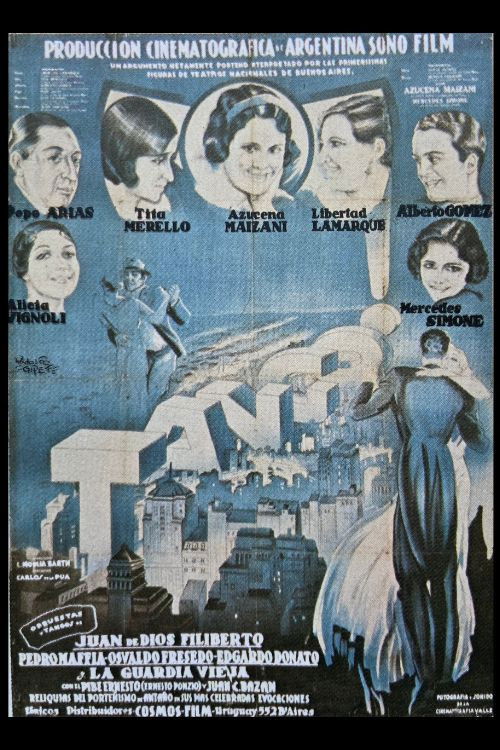
¡Tango! follows a formula established by Carlos Gardel with films such as Luces de Buenos Aires (The Lights of Buenos Aires, 1931) in which a melodramatic story is interspersed with tango songs. However, the film had less dialog and more music, making it more like a musical revue. This format would be copied by many subsequent films. The plot is derived from tango songs. Many of these songs tell of the seduction of an innocent slum girl by a rich man who promises her a glamorous life, but who abandons her when her looks fade. The stylized and sentimental plot of ¡Tango! revolves around a young man who is abandoned by his girlfriend for an older rich man and is heartbroken. The film follows his misfortunes.