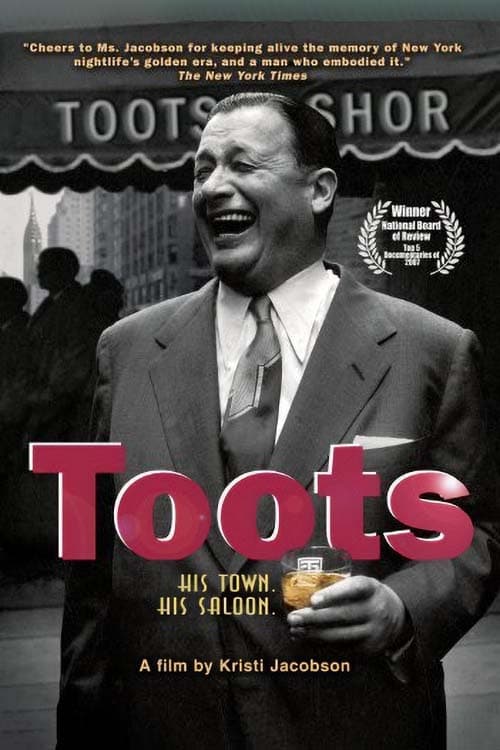
A nostalgic exploration of a legendary restaurateur's life through celebrity interviews and family recollections.
Story Structure — 4 Plot Phases
Genesis and Historical Backdrop
Kristi Jacobson initiates the documentary project and secures Walter Cronkite's participation. The film establishes the historical markers of Toots' career, including Prohibition, the Mafia, and the baseball golden age.
Key Events
Documentary Project Initiation — Kristi Jacobson decides to pursue the documentary project about Toots Shor.
Location: Production Office
Cronkite Outreach Fax — Kristi sends a fax to Walter Cronkite requesting an interview.
Location: Broadcast Network
Cronkite Acceptance — Cronkite replies positively, expressing he knew and loved Toots.
Location: Cronkite's Residence
Prohibition Era Context — The film establishes Prohibition as a key marker of Toots' career.
Location: Historical Archive
Mafia Growth Era — The rise of the Mafia is highlighted as a defining period for Toots.
Location: Historical Archive
Celebrity Recollections and Production
Journalists, broadcasters, and athletes are filmed sharing stories of boozy bonhomie. Tom Brokaw joins as a consulting producer, strengthening the production team.
Key Events
Mafia Growth Era — The rise of the Mafia is highlighted as a defining period for Toots.
Location: Historical Archive
Baseball Golden Age — The golden age of baseball is presented as central to Toots' legacy.
Location: Historical Archive
Saloon Scene Decline — The death of the saloon scene in the 1960s is noted as a cultural shift.
Location: Historical Archive
Journalist Interviews Begin — Kristi films Gay Talese recounting tales of boozy bonhomie.
Location: Studio Set
Broadcaster Interviews Begin — Mike Wallace sits in front of the camera sharing stories.
Location: Studio Set
Athlete Interviews Begin — Athletes Ford and Garagiola are filmed recounting personal tales.
Location: Studio Set
Family Dynamics and Hesitation
Kristi turns to her mother Kerry for personal insights. Kerry initially resists due to a family culture of privacy but eventually consents to the interview.
Key Events
Athlete Interviews Begin — Athletes Ford and Garagiola are filmed recounting personal tales.
Location: Studio Set
Brokaw Joins Production — Tom Brokaw officially signs on as a consulting producer.
Location: Production Office
Family Interview Planning — Kristi prepares to interview her mother, Kerry, about her father.
Location: Family Home
Kerry Jacobson Hesitation — Kerry struggles with the instinct to keep family life private.
Location: Family Home
Kerry Jacobson Consent — Kerry finally consents to the interview, marking a breakthrough.
Location: Family Home
Confirmation Flashback — Kerry recalls Toots attending her confirmation with John Wayne.
Location: Church Venue
Nostalgic Legacy and Reflection
The documentary highlights the Midtown bar's egalitarian spirit and the romantic nostalgia of New York's wealthy era. The film concludes by honoring Toots' enduring memory.
Key Events
Confirmation Flashback — Kerry recalls Toots attending her confirmation with John Wayne.
Location: Church Venue
Midtown Bar Location — The sports bar in Midtown is highlighted as the embodiment of the city's sizzle.
Location: Midtown New York
Celebrity Egalitarianism — The bar is described as a place of glamour and egalitarianism.
Location: The Bar
Working Class Access — Celebrities and working stiffs are shown rubbing elbows together.
Location: The Bar
Private Family Values — The children's upbringing to keep lives private is emphasized.
Location: Studio Set
Documentary Completion — The documentary wraps up, capturing the romantic nostalgia of the era.
Location: Editing Suite
Story Breakdown
Historical Context — The film anchors Toots' career within major American cultural shifts.
Prohibition Era — Establishes the early legal and social landscape of Toots' rise.
Mafia Expansion — Details the organized crime influence during the bar's peak.
Baseball Golden Age — Highlights the sports connection that defined the bar's clientele.
Saloon Decline — Marks the cultural shift in the 1960s that ended the era.
Production Journey — Chronicles the documentary's creation and key partnerships.
Cronkite Outreach — Kristi secures Walter Cronkite's participation via fax.
Brokaw Partnership — Tom Brokaw joins as a consulting producer to bolster credibility.
Studio Setup — Preparation of the filming environment for all interviewees.
Celebrity Interviews — Features testimonials from prominent figures who knew Toots.
Journalist Recollections — Gay Talese shares insights into Toots' social influence.
Broadcaster Testimonials — Mike Wallace recounts personal interactions and bar atmosphere.
Athlete Stories — Whitey Ford and Joe Garagiola discuss sports and dining ties.
Family Dynamics — Explores the private side of Toots through his daughter's perspective.
Mother Hesitation — Kerry Jacobson struggles with family privacy norms.
Daughter Consent — Kerry finally agrees to share personal memories on camera.
Private Upbringing — Reveals how the children were raised away from public bragging.
Bar Legacy — Examines the physical and cultural impact of the Midtown establishment.
Midtown Location — Identifies the bar as the epicenter of New York's social scene.
Celebrity Egalitarianism — Describes how stars and workers shared the same space.
Working Class Access — Highlights the bar's role as a democratic gathering place.
Nostalgic Tone — Sets the emotional atmosphere for the documentary's conclusion.
Romantic Atmosphere — Infuses the narrative with fond memories of a bygone era.
Wealthy New York Era — Captures the city's unique period of wealth and celebrity.
Enduring Memory — Ensures Toots' legacy is preserved through collective recollection.
The '40s and '50s were a classic period in New York City nightlife, when the saloonkeeper was king and regular folks could drink with celebrities like Frank Sinatra and Jackie Gleason. In this documentary, Kristi Jacobson profiles her grandfather, the king of kings: Toots Shor of the eponymous restaurant and saloon, which was once the place to be seen in Manhattan. Edward R. Murrow called Toots Shor the owner of America’s greatest saloon. He became the unlikely den-mother to the heroes of America's golden age. Politicians and gangsters, sports heroes and movie stars - Sinatra, Gleason, DiMaggio, Ruth, Costello, Eisenhower, Nixon, Warren - for 30 years, they all found their way to Toots' eponymous saloon on New York's West 51st Street.