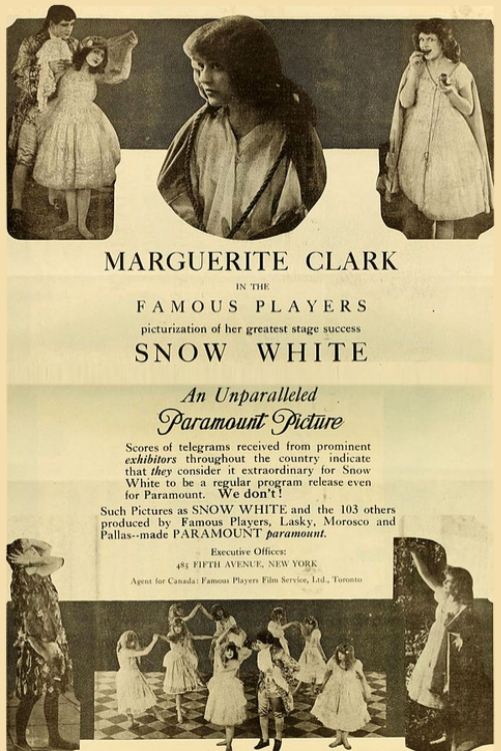
Snow White (1916) character relationship network mapped with AI analysis. Explore the connections, alliances, and conflicts between characters.
Characters
Snow White
(played by Marguerite Clark) — protagonist
The title heroine of this 1916 silent romantic fantasy, played by Marguerite Clark, who reprises her role from the 1912 Broadway production. As the character at the center of the Brothers Grimm-derive...
Snow White's stepmother, played by Dorothy Cumming. Within the adapted fairy-tale narrative she is the queen who stands against the heroine, and her antagonistic role provides the central conflict tha...
Prince Florimon
(played by Creighton Hale) — supporting
The prince of the fairy-tale romance, played by Creighton Hale, who is billed as a star of the film alongside Marguerite Clark. He represents the romantic side of the story and is connected to the her...
Berthold, the huntsman
(played by Lionel Braham) — supporting
The huntsman in the story, played by Lionel Braham. In the classic Brothers Grimm version of the tale, the huntsman is the servant sent by the queen to deal with Snow White in the forest, making him a...
Witch Hex
(played by Alice Washburn) — supporting
A witch character in this screen adaptation, played by Alice Washburn. The provided plot summary does not give specific narrative details about her actions, so she can be identified only as a witch fi...
Dwarf
(played by Herbert Rice) — minor
A dwarf played by Herbert Rice and credited only under the generic role name 'Dwarf'. He belongs to the dwarf group associated with the classic Snow White fairy tale, but the limited plot record does...
Canonical Relationships
Family, romantic, and professional connections based on plot evidence.
Berthold, the huntsman → Queen Brangomar, Snow White's Stepmother
(Professional Employer) — Berthold serves as the huntsman employed by Queen Brangomar
Berthold, the huntsman → Snow White
(Professional Intended Assassin) — Berthold is ordered to kill Snow White but spares her
Queen Brangomar, Snow White's Stepmother → Berthold, the huntsman
(Professional Employer And Employee) — Queen Brangomar orders Berthold to kill Snow White
Snow White → Prince Florimon
(Romantic Interest) — Snow White and Prince Florimon develop a romantic relationship
Snow White → Queen Brangomar, Snow White's Stepmother
(Family Stepdaughter And Stepmother) — Snow White is the stepdaughter of Queen Brangomar
Story Dynamics
Alliances, conflicts, and narrative interactions that evolve throughout the story.
Queen Brangomar, Snow White's Stepmother → Snow White
(Narrative Antagonist) — Queen Brangomar is the main antagonist
Prince Florimon → Snow White
(Narrative Hero) — Prince Florimon is the hero who rescues Snow White
Witch Hex → Berthold, the huntsman
(Conflict Rival) — Witch Hex and Berthold are rivals in serving the Queen
Prince Florimon → Queen Brangomar, Snow White's Stepmother
(Conflict Opposing Force) — Prince Florimon opposes Queen Brangomar's plans
Witch Hex → Snow White
(Conflict Magical Adversary) — Witch Hex works against Snow White using magic
Snow White → Dwarf
(Social Companion) — Snow White befriends the Dwarf and likely other dwarfs
Queen Brangomar, Snow White's Stepmother → Witch Hex
(Alliance Conspirator) — Queen Brangomar allies with Witch Hex to eliminate Snow White
Story Analysis
The supplied reference provides production, adaptation, character, and cultural-impact information rather than a scene-by-scene story account.
Plot Progression
A Silent Fantasy Identified
— The reference identifies the work as a 1916 American silent romantic fantasy film with a 63-minute running time. Snow White is established as the title heroine and narrative center.
The Broadway Legacy
— The film is connected to Winthrop Ames's 1912 Broadway play. Marguerite Clark reprises her stage role as Snow White.
The Grimmian Source
— The Broadway play is identified as an adaptation of the Brothers Grimm fairy tale. The listed Dwarf is associated with the dwarf group from that tradition.
A Later Cultural Echo
— The reference records that Walt Disney saw the film at age fifteen. It states that this experience inspired his later use of the Brothers Grimm fairy tale.