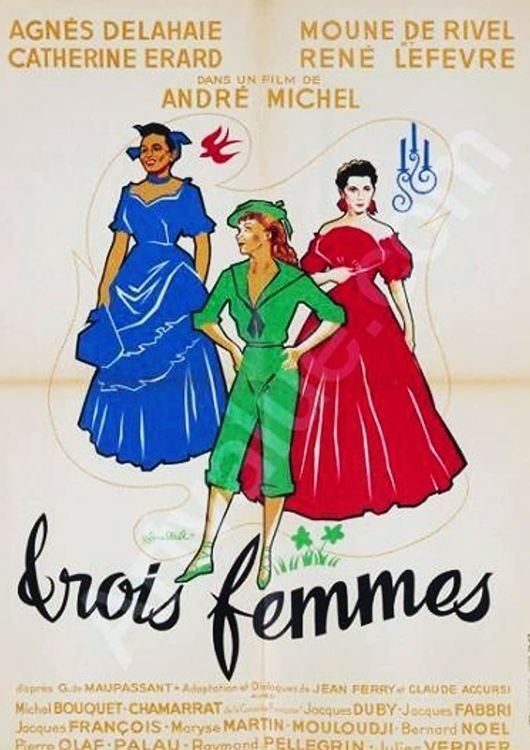
Three interconnected stories about women facing different life challenges
Story Structure — 3 Plot Phases
Zora's Affair
The first segment follows Zora's unrequited love for Monsieur Lesable in her village.
Key Events
Zora's Story Begins — Zora's story introduces her feelings for Monsieur Lesable Characters: Zora, Monsieur Lesable, BoitelleLocation: Zora's village
Mouche's Introduction — The Englishwoman meets Mouche in Paris Characters: The Englishwoman, Mouche, BoisselLocation: Parisian setting
Mouche's Friendship
The second segment explores the relationship between The Englishwoman and Mouche in Paris.
Key Events
Coralie's Inheritance — Coralie learns about her inheritance from Aunt Charlotte Characters: Coralie Cachelin, Aunt Charlotte, An employeeLocation: Family estate
Coralie's Inheritance
The final segment deals with Coralie's struggle for independence from her controlling aunt.
Key Events
Zora's Confession — Zora confesses her feelings to Monsieur Lesable Characters: Zora, Monsieur LesableLocation: Private meeting place
The Englishwoman's Decision — The Englishwoman makes an important decision with Boissel Characters: The Englishwoman, Boissel, MoucheLocation: Workplace
Coralie's Independence — Coralie asserts her independence from Aunt Charlotte Characters: Coralie Cachelin, Aunt CharlotteLocation: Family home
Story Breakdown
Zora's Story — A tale of unrequited love in a village setting
Unrequited Love — Zora's feelings for Monsieur Lesable
Social Constraints — Zora's position in village society
Personal Struggle — Zora's internal conflict
Mouche's Story — A friendship between two women in Paris
Urban Life — Setting in Paris
Female Friendship — Bond between The Englishwoman and Mouche
Professional Context — Relationship with Boissel
Coralie's Story — A struggle for independence within family
Family Dynamics — Relationship with Aunt Charlotte
Inheritance Conflict — Battle over family assets
Personal Growth — Coralie's journey to independence
The short stories of Guy de Maupassant enjoyed a renaissance in the early 1950s, thanks in great part to the Max Ophuls production Le Plaisir. In Trois Femmes, three De Maupassant stories are dramatized, each conveying the central theme of women falling in love. In the first, a black female carnival entertainer causes an uproar when she falls in love with a white soldier. In the second, a young bride is pressured into having a baby to collect a huge inheritance. And in the final episode, a pregnant girl is "adopted" and protected by a small circle of friends. In standard De Maupassant fashion, each of the three stories in Trois Femmes is capped by a surprise twist.