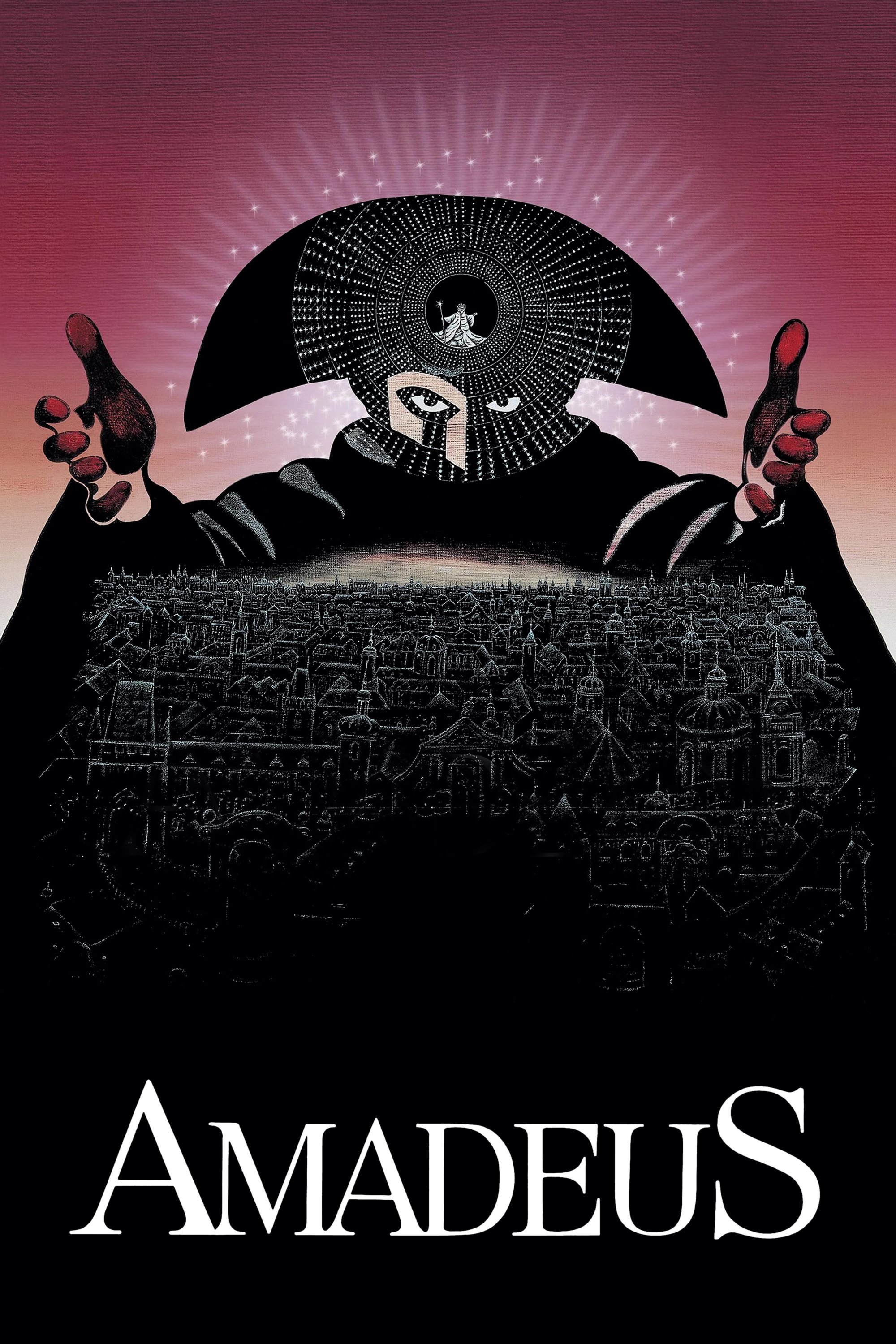
Amadeus (1984) character relationship network mapped with AI analysis. Explore the connections, alliances, and conflicts between characters.
Characters
Antonio Salieri
(played by F. Murray Abraham) — protagonist
A court composer who becomes consumed by jealousy of Wolfgang Amadeus Mozart’s superior talent. He renounces God, vows revenge, sabotages Mozart’s operas, commissions a Requiem under false pretenses,...
Wolfgang Amadeus Mozart
(played by Tom Hulce) — protagonist
A divinely gifted but immature, obscene, and financially reckless composer whose music surpasses Salieri’s abilities. He struggles to find employment, creates major operas, works simultaneously on The...
Constanze Mozart
(played by Elizabeth Berridge) — supporting
Mozart’s wife, who worries about his debts and erratic behavior. She urges him to focus on the Requiem, leaves with their son when his condition becomes alarming, later returns and attempts to remove...
Leopold Mozart
(played by Roy Dotrice) — supporting
Mozart’s father, whose death deeply affects Mozart and contributes to the composition of Don Giovanni. Salieri interprets the opera’s accusing dead commander as representing Mozart’s inferiority compl...
Emperor Joseph II
(played by Jeffrey Jones) — supporting
The Holy Roman Emperor and Salieri’s employer. He lacks musical taste, approves Mozart’s adaptation of The Marriage of Figaro after Mozart persuades him, and later finds the opera boring, contributing...
Salieri's Servant
(played by Philip Lenkowsky) — minor
Young Salieri
(played by Martin Cavani) — minor
Karl Mozart
(played by Milan Demjanenko) — minor
Francesco Salieri
(played by Peter DiGesu) — minor
Father Vogler
(played by Richard Frank) — minor
Salieri's Valet
(played by Vincent Schiavelli) — cameo
Count Almaviva in 'The Marriage of Figaro'
(played by Karel Gult) — cameo
Figaro in 'The Marriage of Figaro'
(played by Miro Grisa) — cameo
Countess in 'The Marriage of Figaro'
(played by Helena Cihelníková) — cameo
Susanna in 'The Marriage of Figaro'
(played by Zuzana Kadlecová) — cameo
Young Mozart
(played by Miroslav Sekera) — cameo
Cherubino in 'The Marriage of Figaro'
(played by Magda Čelakovská) — cameo
Barbarina in 'The Marriage of Figaro'
(played by Slavěna Drášilová) — cameo
Canonical Relationships
Family, romantic, and professional connections based on plot evidence.
Wolfgang Amadeus Mozart → Barbarina in 'The Marriage of Figaro'
(Professional Composer) — Mozart creates the opera containing Barbarina's role.
The plot identifies The Marriage of Figaro as Mozart's operatic project.
Wolfgang Amadeus Mozart → Cherubino in 'The Marriage of Figaro'
(Professional Composer) — Mozart creates the musical role of Cherubino within the opera.
The plot identifies Mozart as the composer who adapts The Marriage of Figaro into an opera.
Wolfgang Amadeus Mozart → Susanna in 'The Marriage of Figaro'
(Professional Composer) — Mozart is professionally connected to Susanna through the opera he composes.
Mozart's adaptation of The Marriage of Figaro includes the opera's named characters.
Wolfgang Amadeus Mozart → Count Almaviva in 'The Marriage of Figaro'
(Professional Composer) — Mozart creates the opera featuring Count Almaviva.
The plot states that Mozart adapts The Marriage of Figaro into an opera.
Wolfgang Amadeus Mozart → Countess in 'The Marriage of Figaro'
(Professional Composer) — Mozart creates the musical work featuring the Countess character.
The plot identifies The Marriage of Figaro as Mozart's operatic adaptation.
Wolfgang Amadeus Mozart → Figaro in 'The Marriage of Figaro'
(Professional Composer) — Mozart creates the opera in which Figaro is a central character.
Mozart boldly adapts the subversive play The Marriage of Figaro into a comedic opera.
Salieri's Valet → Antonio Salieri
(Professional Valet) — The valet serves Salieri within his household setting.
The character list identifies Salieri's Valet as a named attendant connected to Salieri.
Salieri's Servant → Antonio Salieri
(Professional Servant) — The servant belongs to Salieri's domestic and professional environment.
The character list identifies Salieri's Servant as a named member of Salieri's household.
Emperor Joseph II → Wolfgang Amadeus Mozart
(Power Artistic Gatekeeper) — Joseph controls an important part of Mozart's access to Viennese theatrical success.
Mozart convinces the Emperor to approve The Marriage of Figaro, but the Emperor finds the opera boring and it is soon cancelled.
Emperor Joseph II → Antonio Salieri
(Professional Employer) — Joseph employs Salieri as a court composer, giving him institutional status in Vienna.
By 1774, Salieri becomes court composer to Holy Roman Emperor Joseph II.
Young Mozart → Wolfgang Amadeus Mozart
(Temporal Younger Self) — Young Mozart embodies the prodigious talent that later defines the adult composer.
Salieri begins his confession by recalling stories of Mozart as a child prodigy.
Young Salieri → Antonio Salieri
(Temporal Younger Self) — Young Salieri represents the ambitious and devout origin of the older composer's identity.
Salieri's confession recounts his youth, when he prayed to become a famous musician and promised faithfulness, chastity, and diligence.
Constanze Mozart → Karl Mozart
(Family Mother) — Constanze acts as Karl's parent while separating him from Mozart's unstable household.
The plot states that Constanze leaves with their son Karl when she becomes fearful of Mozart's erratic behavior.
Wolfgang Amadeus Mozart → Karl Mozart
(Family Father) — Karl is Mozart's son and part of the family affected by Mozart's deteriorating condition.
Constanze leaves with their son Karl while Mozart continues working on The Magic Flute and the Requiem.
Story Dynamics
Alliances, conflicts, and narrative interactions that evolve throughout the story.
Antonio Salieri → Figaro in 'The Marriage of Figaro'
(Social Audience Member) — Salieri encounters the Figaro production as a rival composer and observer of Mozart's work.
Salieri observes Mozart's adaptation of The Marriage of Figaro and reacts to its reception at court.
Story Analysis
A jealous court composer turns his struggle with divine genius into a confession of rivalry, manipulation, and spiritual defeat.
Plot Progression
The Confession Begins
— An institutionalized Salieri claims responsibility for Mozart's death. Father Vogler's recognition failure leads Salieri to demonstrate Mozart's musical identity and begin his confession.
A Vow Against Silence
— Salieri recalls his forbidden love of music, his bargain with God, and his rise as a court composer. His early ambition is contrasted with the mediocrity he privately recognizes in his environment.
The Genius and the Rival
— Mozart arrives in Vienna and reveals a talent Salieri cannot reconcile with his vulgarity and immaturity. Salieri's admiration becomes spiritual resentment and a vow of revenge.
Operas Under Siege
— Mozart battles institutional resistance through The Marriage of Figaro and Don Giovanni. Salieri repeatedly turns his access to the court against Mozart's artistic ambitions.
The Requiem Trap
— Salieri disguises himself as an anonymous patron and commissions the Requiem as part of a murderous plan. Mozart's simultaneous work on The Magic Flute and the Requiem drives him toward collapse.
A Saint of Mediocrity
— Salieri dictates the Requiem with the dying Mozart and finally acknowledges his superior talent. Mozart dies, receives a pauper's burial, and leaves Salieri without absolution or peace.