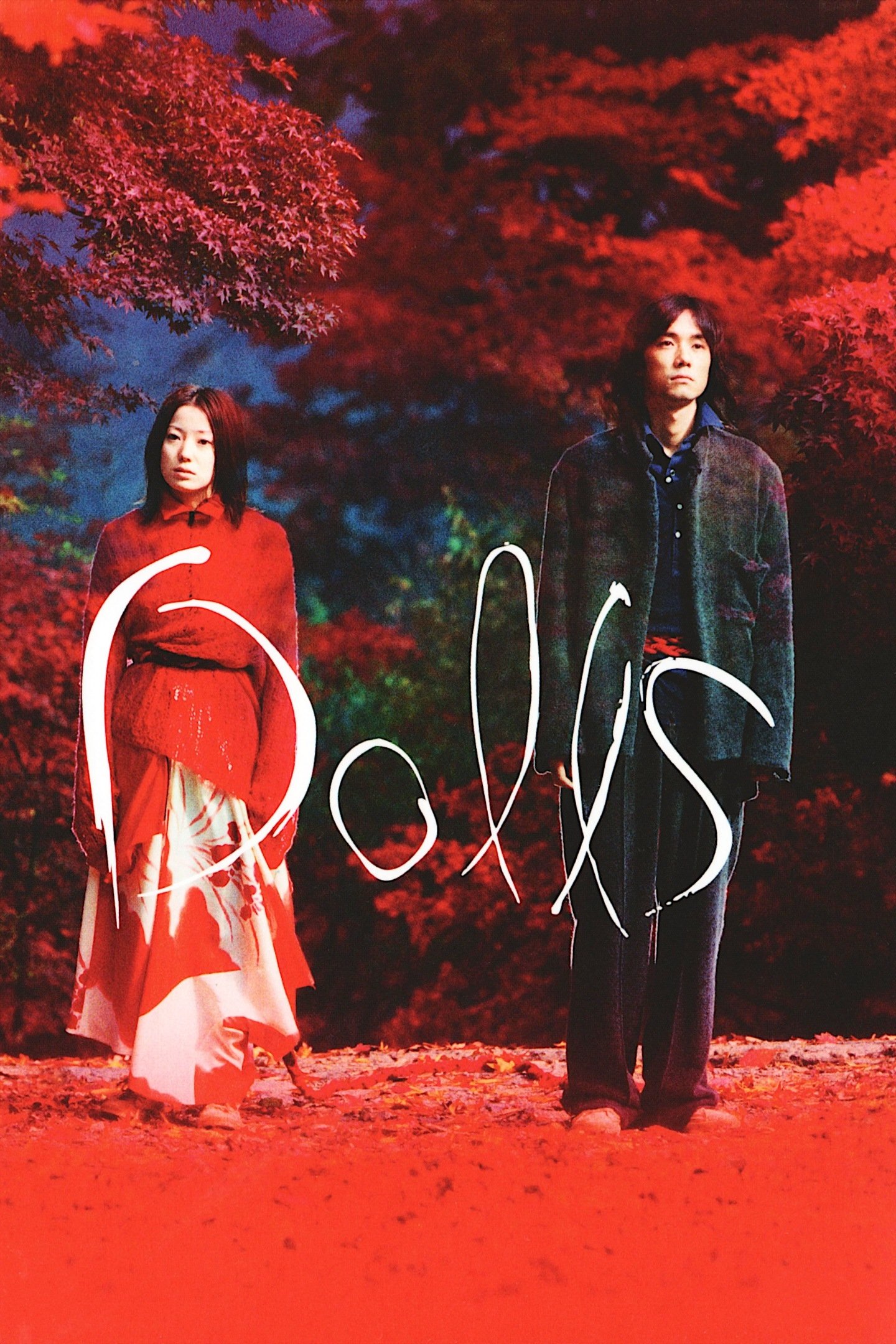
Dolls (2002) character relationship network mapped with AI analysis. Explore the connections, alliances, and conflicts between characters.
Characters
Sawako
(played by Miho Kanno) — protagonist
Sawako is Matsumoto’s former fiancée. After he rejects their engagement to marry for business reasons, she attempts suicide and is left in a semi-catatonic state. Matsumoto removes her from the hospit...
Matsumoto
(played by Hidetoshi Nishijima) — protagonist
Matsumoto is a young man who abandons his engagement to Sawako in order to marry the company president’s daughter. When Sawako attempts suicide and becomes semi-catatonic, he takes her out of the hosp...
Hiro
(played by Tatsuya Mihashi) — supporting
Hiro is an aged yakuza whose story follows an attempt to meet the girlfriend he left behind in his youth. His search forms one of the film’s three interconnected narratives and reflects the film’s rec...
Haruna's Manager
(played by Ren Osugi) — supporting
Matsumoto's Mother
(played by Midori Kanazawa) — minor
Matsumoto's Father
(played by Shogo Shimizu) — minor
Haruna's Mother
(played by Kyoko Yoshizawa) — minor
Nukui
(played by Tsutomu Takeshige) — supporting
Nukui is a young man obsessively devoted to the pop star Haruna Yamaguchi. When Haruna suffers a disfiguring car accident, he blinds himself in response, making his devotion physically irreversible. H...
Matsumoto's Colleague
(played by Nao Omori) — supporting
Canonical Relationships
Family, romantic, and professional connections based on plot evidence.
Matsumoto's Father → Matsumoto
(father)
Matsumoto's Mother → Matsumoto
(mother)
Haruna's Mother → Haruna's Manager
(mother)
Matsumoto's Colleague → Matsumoto
(colleague)
Matsumoto → Sawako
(Romantic Former Fiancés) — Their broken engagement develops into a tragic, enduring emotional bond.
Matsumoto rejects his engagement to Sawako, and Sawako later attempts suicide after the rejection.
Story Dynamics
Alliances, conflicts, and narrative interactions that evolve throughout the story.
Hiro → Nukui
(Narrative Parallel Story Counterparts) — Their narratives echo the film's broader meditation on devotion, loss, and time.
Hiro's story and Nukui's story are presented as separate stories that share incidental visual crossover.
Matsumoto → Hiro
(Narrative Parallel Story Counterparts) — Their separate journeys contribute to the film's interconnected narrative design.
Matsumoto's story and Hiro's story are distinct but have incidental visual crossover within the film.
Matsumoto → Nukui
(Narrative Parallel Story Counterparts) — They function as characters in parallel stories connected by the film's symbolic structure.
The film presents Matsumoto's story and Nukui's story as separate narratives with incidental visual crossover.
Story Analysis
Three visually connected stories transform romantic devotion, suffering, and the passage of time into a cinematic Bunraku tragedy.
Plot Progression
The Broken Engagement
— Matsumoto rejects Sawako after becoming engaged to the company president's daughter. Sawako's suicide attempt leaves her semi-catatonic and transforms their relationship into the film's central traged...
Escape into Exile
— Matsumoto removes Sawako from the hospital and runs away with her. Their physical connection through the red rope becomes the main image of their damaged but continuing bond.
Echoes of Devotion
— Hiro searches for a girlfriend from his youth, while Nukui's obsessive devotion to a pop star develops in a separate story. Their narratives visually cross over with the central journey.
Wounds of Obsession
— The pop star's disfiguring car accident leads Nukui to blind himself. The parallel stories intensify the film's themes of devotion, suffering, and irreversible loss.
Dolls Beyond Time
— Seasonal change and recurring visual connections make the stories increasingly symbolic and difficult to separate from theatrical representation. The closing dolls return the film to its Bunraku frame...