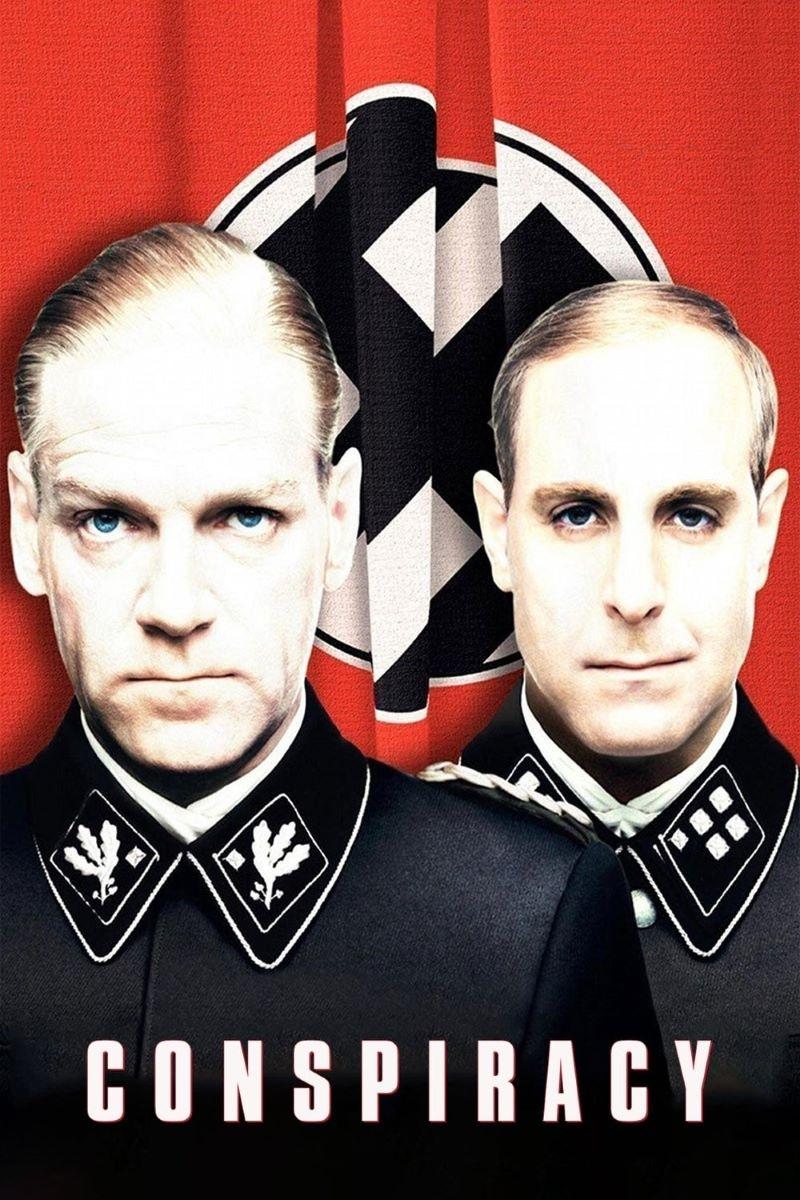
Conspiracy (2001) character relationship network mapped with AI analysis. Explore the connections, alliances, and conflicts between characters.
Chairs the Wannsee conference and leads the discussion on the complete solution of the Jewish question. He outlines government policy, dismisses alternative proposals, reveals the plan for mass exterm...
Serves as Heydrich's key assistant at the conference. He helps manage the discussion, dismisses other officials' proposed solutions, and reveals the SS's secret preparations for extermination camps in...
A lawyer in the Reich Ministry for the Interior and co-author of the Nuremberg Laws. He expresses anger over the administrative and legal chaos the killings would cause. Heydrich takes him aside to wa...
An attendee who insists that Jews in the overpopulated ghettos under his control in occupied Poland should be dealt with first.
Causes an outburst during the meeting, which forces Heydrich to explicitly clarify that the policy of evacuation actually means extermination.
German Foreign Office secretary. His copy of the Wannsee conference minutes is noted as the only surviving record of the meeting, recovered by the US Army in 1947.
Family, romantic, and professional connections based on plot evidence.
Martin Luther is identified as the German Foreign Office secretary whose copy of the Wannsee minutes later survives.
The plot states that Adolf Eichmann assists Reinhard Heydrich in managing the conference and dismissing proposed solutions.
Alliances, conflicts, and narrative interactions that evolve throughout the story.
Eichmann is present when Heydrich recounts Kritzinger's warning after the meeting and dismisses its concern.
The plot describes tensions among attendees arising from competing interests, including Stuckart's legal concerns and Bühler's demand concerning occup...
Both officials express reservations during the conference: Kritzinger questions its purpose, while Stuckart objects to the legal consequences of the k...
Stuckart objects to the legal and administrative chaos caused by the killings, while Eichmann assists Heydrich in dismissing competing proposals.
Bühler proposes dealing with the ghettos in occupied Poland first, while Eichmann helps dismiss the attendees' alternative solutions.
Bühler insists that the Jews in the ghettos under his control in occupied Poland should be dealt with first, while Heydrich directs the broader policy...
Lange's outburst interrupts the discussion that Eichmann is helping Heydrich manage and forces a direct explanation of the policy.
Lange's outburst forces Heydrich to clarify that evacuation means extermination.
Heydrich takes Kritzinger aside and intimidates him into giving explicit support to the policy.
Stuckart objects that the killings would create administrative and legal chaos, and Heydrich warns him about the consequences of his stubbornness.
A bureaucratic conference transforms mass murder into an organized state policy while exposing the moral collapse of its participants.
Directed by Frank Pierson
Conspiracy (2001) · 7.3/10 · drama, history, tv-movie, war
Plot analysis generated from content on Wikipedia, licensed under CC BY-SA 4.0.
Related entry on Wikidata (Q706367), public domain (CC0).