Story Structure — 5 Plot Phases
A Production Expands
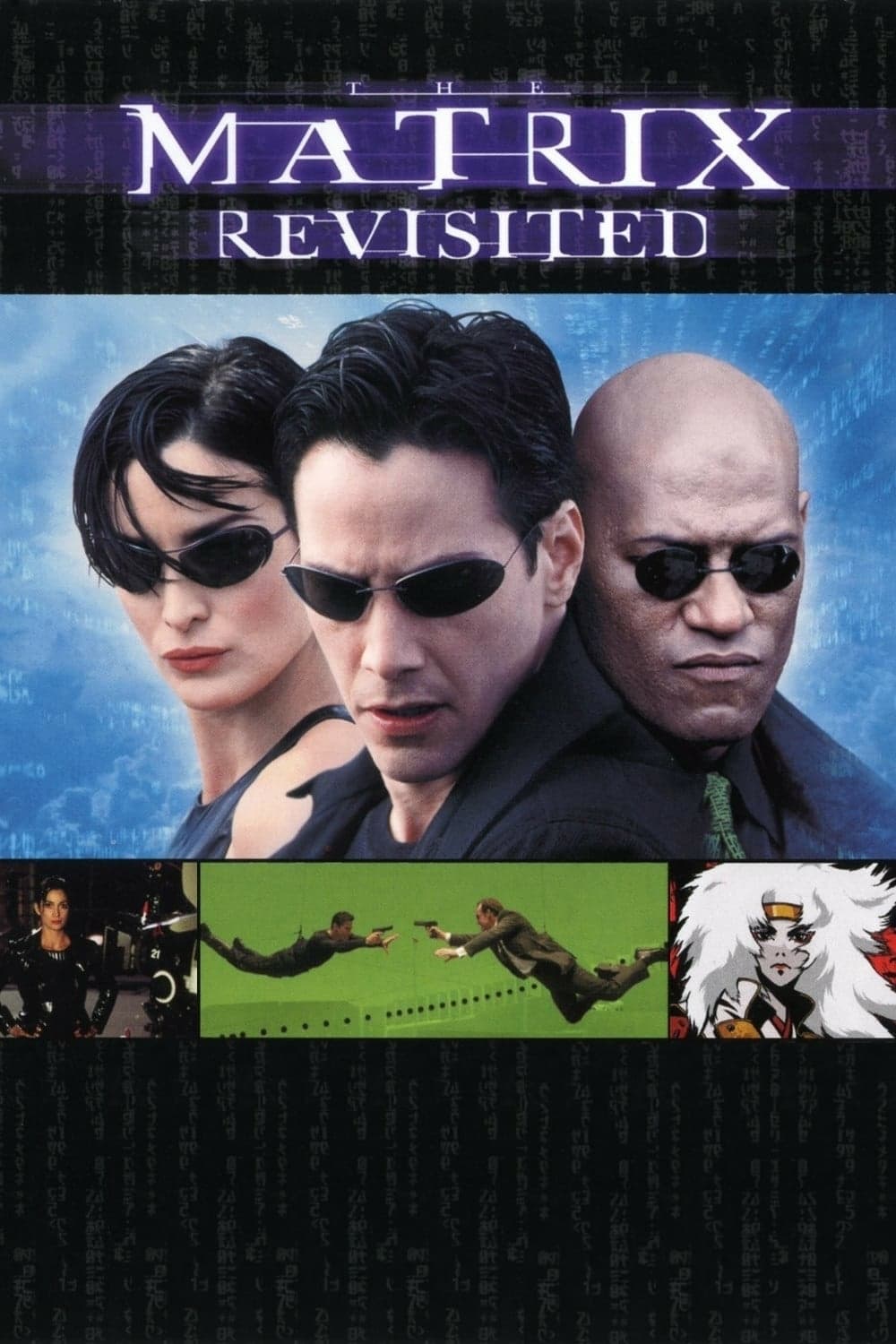
The documentary introduces the enthusiastic response to The Matrix and the preparation of two sequels together. Casting, design, testing, and the move to a larger facility reveal a dramatic expansion in scale.
Key Events
-
Enthusiastic Response to The Matrix — The documentary opens with enthusiastic reactions to The Matrix and its increasingly ambitious continuation.
Location: Documentary opening
-
Two Sequels Prepared Together — The production team explains that the next two films are being prepared together.
Location: Production facility
-
Casting and Fight Tests — Casting, physical-fight tests, special-effects experiments, and head casts demonstrate the expanded preparation.
Location: Production facility
-
Costume and Concept Planning — Costume planning and an expanding group of concept artists support the sequels' larger creative requirements.
Location: Design department
-
From Warehouse to Facility — The new facility is contrasted with the original film's modest Burbank warehouse.
Location: Burbank warehouse and new facility
Worlds Take Shape
Designers establish contrasting visual languages for the Matrix and the human world. Physical environments are developed from concept drawings while practical filmmaking limits shape the designs.
Key Events
-
From Warehouse to Facility — The new facility is contrasted with the original film's modest Burbank warehouse.
Location: Burbank warehouse and new facility
-
Sequels Demand Coordination — Filmmakers recall the uncertainty of the original project and the extensive coordination now required.
Location: Production facility
-
Green Matrix Visual Bias — Designers give the Matrix a green visual bias.
Location: Design department
-
Blue Human World — The human world uses blue tones, longer lenses, softer backgrounds, and more natural styling.
Location: Design department
-
Physical Environment Construction — Large detailed environments are built from drawings while adapting designs to gravity and live action.
Location: Construction and design spaces
Glitches and Physical Risk
Identical twins and triplets support a sequence about déjà vu and system glitches. Training then exposes the physical demands of contact fighting, wire work, and dangerous stunt impacts.
Key Events
-
Physical Environment Construction — Large detailed environments are built from drawings while adapting designs to gravity and live action.
Location: Construction and design spaces
-
Identical Twin Casting — Groups of identical twins and triplets are cast for a sequence involving déjà vu and system glitches.
Location: Fountain sequence set
-
Agent Smith Fight Practice — Self - Agent Smith practices flying punches during the action preparation. Characters: Self - Agent Smith
Location: Training space
-
Contact Fighting Training — Performers and stunt personnel learn that the fights require genuine physical contact.
Location: Training space
-
Wire Work Risks — Wire work introduces additional risks as performers prepare demanding movements and impacts.
Location: Stunt-training area
-
Stunt Impact Demonstrations — A stuntman performs an upside-down collision and a fall that would be too dangerous for an actor.
Location: Stunt set
Engineering the Helicopter
The subway sequence demonstrates how specialized sets control complex action. The helicopter sequence raises the technical challenge through glass, explosives, miniatures, stunts, and digital backgrounds.
Key Events
-
Stunt Impact Demonstrations — A stuntman performs an upside-down collision and a fall that would be too dangerous for an actor.
Location: Stunt set
-
Subway Set Construction — The subway sequence is built on a specialized set to control choreography, weapons, harnesses, and impacts.
Location: Specialized subway set
-
Helicopter Sequence Begins — A helicopter sequence combines live action, stunts, a full-scale glass wall, a miniature helicopter, and explosives.
Location: Helicopter sequence set
-
Glass Explosion Research — The crew researches expanding concentric circles to make the glass explode convincingly.
Location: Effects research area
-
Camera Movement Simulation — Extensive simulation is used to design camera movement and timing for the helicopter effects.
Location: Effects planning space
Craft Becomes Computation
Research and simulation coordinate the helicopter's glass explosion, camera movement, and timing. The documentary concludes with reconstructed environments and computer-generated creatures that merge practical craft with digital production.
Key Events
-
Camera Movement Simulation — Extensive simulation is used to design camera movement and timing for the helicopter effects.
Location: Effects planning space
-
Digital World Reconstruction — Reconstructed environments and hundreds of cameras transform difficult practical shots into controlled digital worlds.
Location: Digital effects environment
-
Computer Generated Creatures — Creatures inspired by undersea life demonstrate the scale of physical craftsmanship and visual computation.
Location: Computer-generated world
The film goes behind the scenes of the 1999 sci-fi movie The Matrix.