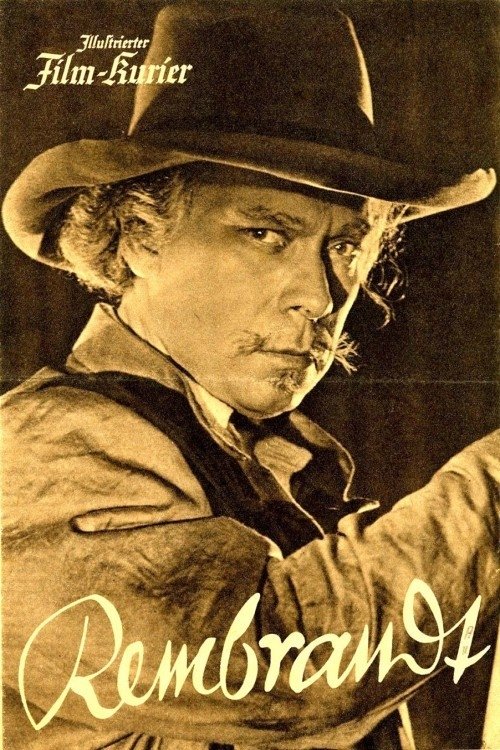
A meta-narrative analysis of the film's creative origins, production logistics, and historical adaptation.
The film is introduced as a 1942 German historical drama directed by Hans Steinhoff, featuring a principal cast of Ewald Balser, Hertha Feiler, Gisela Uhlen, and Aribert Wäscher.
The narrative framework is established through Valerian Tornius's novel Zwischen Hell und Dunkel, which serves as the direct source material for depicting Rembrandt's life.
Filming progresses through Berlin studios under art director Walter Röhrig's set designs, transitioning to location shooting in German-occupied Amsterdam and Cinetone Studios.
The production culminates in the cinematic portrayal of the Dutch painter, integrating studio craftsmanship with authentic Amsterdam locations to complete the historical drama.
Already a famous painter, Rembrandt van Rijn is commissioned to paint the Amsterdam Archers' Guild. But upon completion of the picture, the men of the guild feel duped, because they don't consider themselves flatteringly depicted in the painting. They therefore decline to pay for the work. During this dispute, the painter finds out his wife is close to death. He finds himself terribly lonely after her passing and suffers from depression until he decides once more to marry.
Hans Steinhoff
Rating: 5.5/10 (6 votes)
Plot analysis generated from content on Wikipedia, licensed under CC BY-SA 4.0.
Related entry on Wikidata (Q324717), public domain (CC0).